
Article
Choosing the Best Filler Type for Each Treatment Area

An independent partner surgeon checked the medical claims on this page. What applies to your own case is decided by the surgeon who examines you.
Written by the editorial team, not by a clinician. Nothing here is medical advice: your independent partner surgeon decides what applies to you.
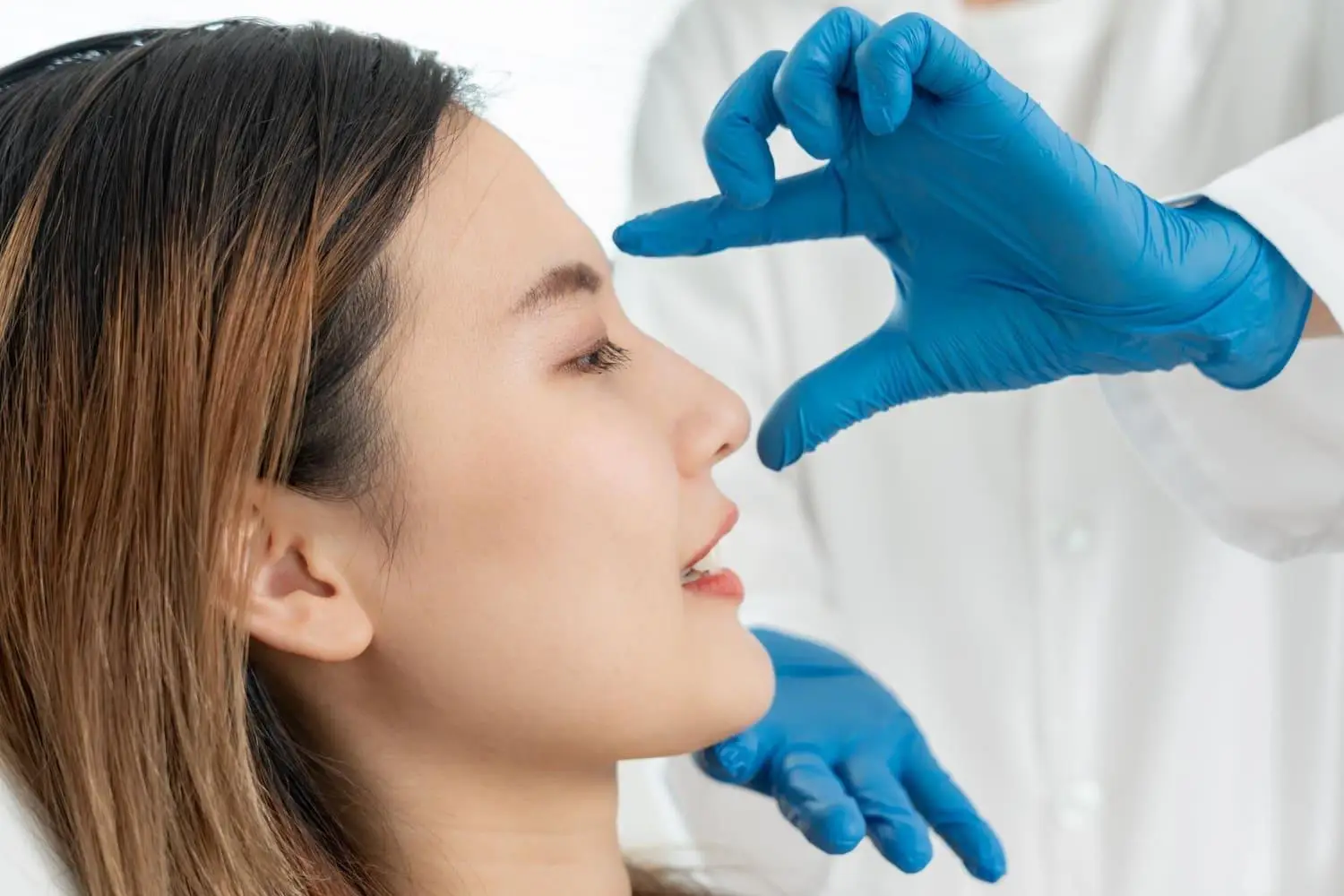
Most people arrive holding a brand name, having read that one product is for lips and another for cheeks. That is the wrong first question. What separates one syringe from another is not the label but how tightly the gel is cross-linked and how stiff it is in tissue.
Cross-linking sets how long the material survives. The elastic modulus, written G-prime, sets how hard the gel pushes back when the face moves. A soft gel looks natural in a lip and settles into a hollow without an edge; a firm gel holds a jawline against gravity. Swap them and both fail: the firm gel lumps, the soft one gives a chin nothing to sit on.
What separates one filler from another
Cross-linking sets duration
Hyaluronic acid is a sugar the body already makes and already breaks down, so manufacturers chemically link the chains together. The relationship is direct: the greater the degree of cross-linking, the harder the gel becomes and the longer it persists in soft tissue (Fundarò and colleagues, 2022).
G-prime sets depth
G-prime measures resistance to deformation. Marketed hyaluronic acid products run from 40 Pa at the soft end to 1,055 Pa at the firm end (de la Guardia and colleagues, 2022): roughly 6.9 Pa for fine lines, 173 Pa for nasolabial folds and 603 Pa for a cheek volumiser (Fundarò and colleagues, 2022). High G-prime fillers go into deep fat or the pre-periosteal plane, intermediate gels into superficial fat, and only low G-prime gels belong in the dermis. Too shallow, a firm gel reads as a ridge; a soft gel on bone lifts nothing.
Cohesivity and water uptake
Cohesivity decides whether the gel holds a shape or spreads. Water uptake is separate, ranging across products from under 100 per cent to around 700 per cent. Under the eyes, a filler with low water uptake limits swelling and puffiness (de la Guardia and colleagues, 2022).
Area by area
| Area | What the gel has to do | Property that follows | Typical stated duration |
|---|---|---|---|
| Lips | Move with the muscle, stay soft, show no edges | Low to medium G-prime and cohesivity | 6 to 12 months (HA) |
| Cheeks and midface | Lift and hold projection | High G-prime, medium to high cohesivity | 6 to 12 months (HA), 18 months (CaHA) |
| Chin and jawline | Build a defined edge over bone | High G-prime, pre-periosteal | 6 to 12 months (HA), 18 months (CaHA) |
| Tear trough | Fill a shallow hollow under thin skin | Low to medium G-prime, low cohesivity, low water uptake | Stated 6 to 12 months, imaging shows far longer |
| Nose, non-surgical | Add midline height over cartilage and bone | High G-prime and deep, high-risk vascular zone | 6 to 12 months |
The FDA states that cross-linked hyaluronic acid lasts approximately 6 to 12 months, calcium hydroxylapatite approximately 18 months and poly-L-lactic acid up to 2 years. Those figures describe the visible effect, not how long the material is present.
Lips versus jawline
Lips are thin, mobile and deformed constantly by muscle, so the gels used there are soft: low to medium elasticity and cohesivity (de la Guardia and colleagues, 2022). A high G-prime gel resists that movement instead of travelling with it, which is how hard edges and lumps appear in a lip injected with a product meant for a cheek. Where the goal is volume and support the requirement inverts, to high elasticity and medium to high cohesivity, with cheeks, chin and jawline taking a high G-prime product placed against bone (Rohrich and colleagues, 2019). No amount of injection skill turns one material into the other.
The tear trough is the difficult one
Under-eye skin is the thinnest on the face and the anatomy is crowded: the infraorbital artery and nerve emerge through the infraorbital foramen approximately 3 cm lateral to the midline, just below the orbital rim (Zein and colleagues, 2020). The brief calls for low to medium elasticity, low cohesivity, low water affinity and deep placement.
The Tyndall effect
The Tyndall effect is a blue-grey discolouration from filler placed too superficially, caused by blue light scattering through small particles in suspension. The primary preventive measure is deep injection (Zein and colleagues, 2020).
A prospective study of 24 patients across 48 tear troughs recorded mild swelling in 22 of 24 immediately afterwards; at day 14, 6 of 24 still had mild swelling and 1 moderate; at four weeks, 2 of 24 still had swelling. None developed the Tyndall effect (Diwan and colleagues, 2020).
The 6 to 12 month figure describes the visible effect, not the disappearance of the gel. An MRI review of 33 patients found hyaluronic acid still present in every one, with no complete dissipation over the two years after injection: 21 had gone 2 to 5 years without a midface injection, 12 more than 5 years, one more than 15 (Master and colleagues, 2024). Top-ups layered onto material that never left can build a permanently heavy look.
What can go wrong, with the numbers
Filler is sold as a lunchtime procedure and usually behaves like one. The exception is vascular: gel entering an artery, blocking it, and cutting the blood supply to skin or to the eye. One practical review puts vascular occlusion, excluding blindness, at up to 3 in 1,000 (Rohrich and colleagues, 2019). A prospective national estimate is lower: 44 patients with vascular adverse events referred to a specialist clinic over 25 months, against 138,496 filler treatments performed in the Netherlands in 2016, gives 1 in 6,558, or 0.015 per cent (Schelke and colleagues, 2020). Small, but not zero.
A systematic review identified 190 published cases of filler-induced blindness: autologous fat accounted for 90, or 47 per cent, and hyaluronic acid for 53, or 28 per cent (Chatrath and colleagues, 2019). A later analysis found the regions with complex vasculature, the glabella, nose and nasolabial folds, were most commonly implicated (Chakhachiro and Waseem, 2025). The non-surgical nose is on that list.
The timescale is unforgiving. Retinal circulation needs restoring within 60 to 90 minutes if the retina is to survive, and hyaluronidase should be given optimally within 4 hours (Kroumpouzos and Treacy, 2024). In the blindness review, 11 hyaluronic acid cases improved in visual acuity and 6 recovered vision completely; outcomes were not good in any case caused by another material.
Delayed-onset nodules have been reported at up to 0.8 per cent in one series, and at 1 to 4.25 per cent for low molecular weight hyaluronic acid; they can be triggered weeks or months later by an illness or a vaccination (Convery and colleagues, 2021).
Why reversibility matters
Hyaluronidase breaks hyaluronic acid down, and dosing scales with the problem: 30 to 75 international units can resolve a Tyndall effect, a vascular occlusion 450 to 1,500 units across up to four pulsed cycles (Kroumpouzos and Treacy, 2024). What it cannot touch is the decisive point. Poly-L-lactic acid, calcium hydroxylapatite and polymethylmethacrylate cannot be dissolved, so if one of those blocks a vessel there is no antidote.
| Material class | How it works | Dissolvable | Stated duration |
|---|---|---|---|
| Hyaluronic acid, cross-linked | Binds water and occupies space | Yes | 6 to 12 months |
| Calcium hydroxylapatite | Microspheres of 25 to 45 micrometres stimulate collagen; visible on x-ray | No | About 18 months |
| Poly-L-lactic acid | Particles of 2 to 150 micrometres drive a macrophage-led collagen response | No | Up to 2 years |
| Polymethylmethacrylate beads | Non-absorbable beads in a bovine collagen carrier | No | Permanent |
Durations and the x-ray and non-absorbability notes are from the FDA, which also states that liquid silicone has not been approved for injection anywhere in the body.
Who holds the syringe
Product choice is the easy half. Published safety guidance is mostly about the injector: anatomy and facial danger zones have to be respected (Rohrich and colleagues, 2019), and the recommended measures are blunt-tipped cannulae rather than sharp needles in high-risk areas, slow retrograde injection, and aspirating before injecting (Chakhachiro and Waseem, 2025). A clinic with no hyaluronidase on site and no protocol for a vascular event is not equipped for what it sells.
Questions worth asking
- Which material class is being used, and can it be dissolved if the result is wrong?
- Is hyaluronidase kept on site, and who there is trained to use it in an emergency?
- What is the injector’s medical qualification, and how much of their work is in this area of the face?
- What is the plan if a nodule appears six weeks later, after treatment has finished?
How this fits with treatment in Istanbul
Istanbul European Clinic is a medical travel coordination company. It does not perform procedures, employ doctors or own a facility. Its role is to pass an enquiry to an independent partner surgeon and organise the trip.
There is no filler treatment page here, and that is deliberate. Several of the independent partner surgeons, including plastic surgery and ear, nose and throat specialists, list filler and botulinum toxin among their non-surgical work, so an injectable question can be passed on and coordinated. But the coordination work is built around surgical procedures, and a filler appointment is a poor reason to book a flight. Delayed-onset nodules surface weeks or months later, and treating a hyaluronic acid problem needs someone who can examine your face in person. If the injection happened in another country, that person is several flights away.
If what you want is a lasting change to the shape of the nose, a gel is not a smaller version of that operation, and the rhinoplasty page is the better starting point; for anything broader, the plastic surgery page sets out what is coordinated. Your independent partner surgeon decides what applies, including when the answer is that nothing should be injected.
Sources
- International Journal of Molecular Sciences (rheology of HA fillers), 2022
- Facial Plastic Surgery (rheologic and physicochemical characteristics of HA fillers), 2022
- Plastic and Reconstructive Surgery Global Open (practical approach and safety of HA fillers), 2019
- US Food and Drug Administration, FDA-Approved Dermal Fillers, 2020
- Plastic and Reconstructive Surgery Global Open (systematic review of filler-associated blindness), 2019
- Aesthetic Surgery Journal (incidence of vascular obstruction after filler injections), 2020
- Plastic and Aesthetic Research (complications after cosmetic periocular filler), 2020
- JMIR Dermatology (hyaluronidase applications and dosage recommendations), 2024
- Plastic and Reconstructive Surgery Global Open (MRI review of HA filler longevity in the mid-face), 2024
- Plastic and Reconstructive Surgery Global Open (prospective tear trough study), 2020
- Journal of Clinical and Aesthetic Dermatology (delayed-onset nodules after HA fillers), 2021
- Cureus (risk factor analysis for vascular occlusions after dermal fillers), 2025
- Skin Research and Technology (morphological analysis of CaHA and PLLA particles), 2024