
Hair restoration for women · coordinated in Istanbul
Hair transplant for women in Turkey
Hair loss in women is not one condition, and that is the whole difficulty with this page. Before a transplant is a question about technique or price, it is a question about diagnosis: iron deficiency, thyroid dysfunction, the diffuse shedding that follows childbirth or illness, and scarring conditions all thin women's hair, and not one of them is fixed by moving follicles. Some women are excellent candidates for surgery. Which women, is something that gets measured rather than assumed.
Istanbul European Clinic Medical Travel Services is a medical travel coordination company in Istanbul: we work with independent partner surgeons who operate at their own clinics or at accredited hospitals. A bilingual coordinator handles your dates, hotel, transfers and interpreting, while every clinical decision, including whether a transplant is the right treatment for your hair loss at all, is made independently by your chosen partner surgeon. Istanbul European Clinic does not perform procedures and does not guarantee outcomes.
An independent partner surgeon checked the medical claims on this page. What applies to your own case is decided by the surgeon who examines you.
Start with the diagnosis, not the technique
This is the part of the decision a price comparison cannot help with, so it goes first. Women lose hair for reasons that look similar in the mirror and are not similar at all underneath, and a transplant addresses only one of them.
A 2025 review of male and female pattern hair loss in Australian Prescriber sets out the sequence, and it is not the sequence most clinic websites follow. It states that "a detailed history and thorough clinical examination can help differentiate potential causes". It says nutritional deficiencies such as iron deficiency, and metabolic disorders such as thyroid dysfunction, should be treated "prior to starting treatment for hair loss". It says associated conditions such as tinea capitis and seborrhoeic dermatitis should be addressed, and that scarring alopecia has to be excluded.
Read that as a list of things a transplant does not do. A graft moved into a scalp with untreated iron deficiency is still a graft in a scalp with untreated iron deficiency. Hair thinning because of a thyroid problem does not stop thinning because some of it was relocated. And in scarring alopecia, where the follicle has been destroyed and replaced by scar tissue, operating on an active disease is not a neutral act.
- Iron deficiency and thyroid dysfunction. Treatable, common, and specifically named in the 2025 review as things to treat before hair-loss treatment begins. A blood test is not a formality a good clinic skips to save you time.
- Telogen effluvium. Diffuse shedding that follows childbirth, surgery, serious illness or rapid weight loss. It is alarming, it is not pattern hair loss, and it has its own course. Operating on a scalp in the middle of it is treating the wrong thing.
- Scarring alopecia. Has to be excluded, in the review's own framing, before anything else. The follicle is gone rather than shrunken. This is the category where a transplant can be actively wrong rather than merely useless.
- Tinea capitis and seborrhoeic dermatitis. Conditions that come along with hair loss and get addressed as part of the work-up. They are scalp problems, and they are answered with treatment rather than surgery.
- Female pattern hair loss. The diagnosis a transplant is actually for, and the one you arrive at by ruling the others out rather than by looking at a photograph.
Nothing here says a woman cannot have a hair transplant. It says the question "am I a candidate" is not answerable until this list has been worked through, and that any answer arriving before the list has been worked through was not an answer to that question.
Why your donor area decides this, and why that is different for women
The standard hair transplant story assumes a clean division of the scalp: a thinning zone at the front and top, and a dense, unaffected reserve at the back and sides to move hair from. That division is what makes the operation work at all, because a transplant does not create hair. It spends a reserve.
Female hair loss tends to be diffuse rather than sharply demarcated, and the consequence is worth thinking through slowly, because it is arithmetic rather than opinion. If the thinning includes the back and sides, then the reserve is not a reserve. The follicles taken from it are the same follicles that were already producing finer hair, and they do not improve by being moved. You would be relocating thinning hair from a place where it is spread out to a place where it will be spread out slightly less. So for a woman, assessing the donor area is not a preliminary step before the candidacy decision. It is the candidacy decision.
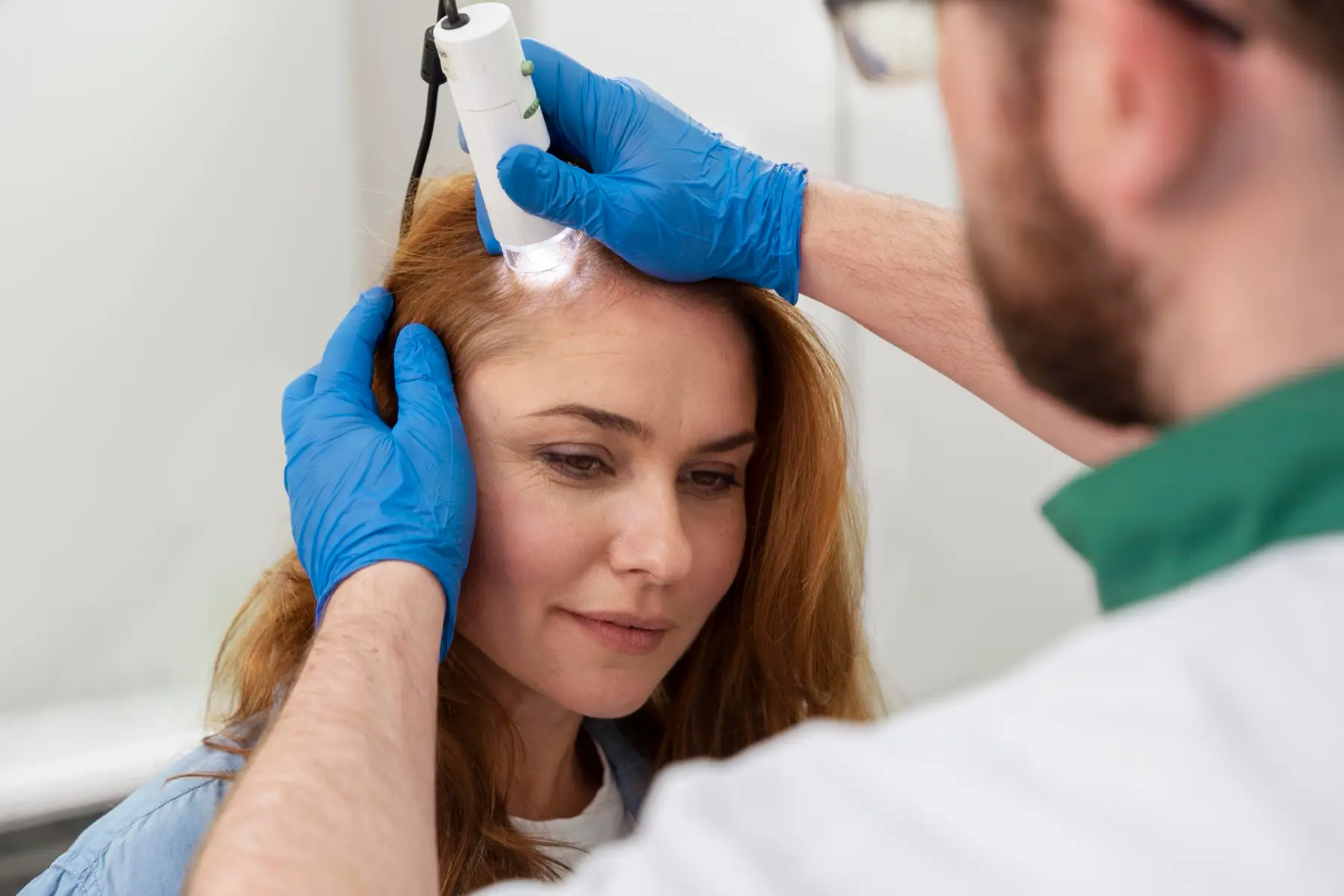
The useful thing about that is it can be measured. Donor density is something a surgeon looks at under magnification and counts, and the number is either there or it is not. It is also the single thing a photograph sent over a messaging app is worst at.
There is a ceiling on the reserve as well as a question about it. A 2026 review in Frontiers in Medicine notes that many authors recommend limiting extractions to 10% to 20% of the baseline follicular unit density per session. Past that, the published consequence is permanent donor depletion, and the word carrying the weight in that phrase is permanent. The donor area does not grow back, and it is also where a second session would have to come from.
- Ask what your donor density is, as a number. Not whether it "looks good". If nobody measured it, nobody planned it.
- Ask whether your donor area is affected too. This is the female-specific question and the one most likely to change the answer. A surgeon who has not raised it has not looked.
- Ask what percentage of it the plan takes. The published ceiling is 10% to 20% per session. A plan that cannot state its own percentage has not been checked against one.
- Ask what is left afterwards. If your hair loss has not stabilised you may need a second procedure later, and it comes out of the same finite reserve.
A flat package price makes this sharper rather than softer. When the graft count does not change the invoice, nothing financial is limiting how much comes out of your donor area. What is left limiting it is the surgeon's judgement, and that is the thing you are really choosing.
Who is a realistic candidate
This page is not an argument that women should not have hair transplants. Plenty of women get very good results, and they tend to have the same things in common.
- The cause has been diagnosed, and anything treatable has been treated. Everything else on this list is downstream of this one.
- The hair loss has stabilised. A stable pattern is what makes a plan possible. Loss that is still moving turns any plan into a guess about the future.
- The donor area has density to spare. Measured rather than assumed, and not visibly caught up in the same thinning.
- The loss is localised rather than everywhere. A broad or high forehead you want brought forward, a defined patch of traction alopecia from years of tight styling, an area where an old surgical scar sits: these are the cases where a transplant has a defined target and a defined amount of work to do.
- The cause has stopped, if the cause was mechanical. Traction alopecia is a good indication precisely because the cause is obvious. If the tight styling continues after the surgery, so does the traction, and so does the loss.
- Expectations are about density, not about a new head of hair. A transplant redistributes what you already have. Where the loss is diffuse, the realistic goal is usually making a specific area read as fuller, not restoring the hair you had at twenty.
- Patience. Twelve to eighteen months to a settled result, with a discouraging middle in which the transplanted hair sheds before it grows.
If you recognise yourself in that list, this is a reasonable thing to look into. If you recognise yourself in one or two items and not the rest, that is not a rejection. It is the information a consultation exists to produce, and it is worth more to you than a date in a calendar.
What a real assessment looks like, and what a sales answer looks like
You can tell these two apart before you spend anything, and for a woman with hair loss it is the most useful skill on this page.
A clinic that has your photographs and nothing else can tell you what a package costs. It cannot tell you whether you are a candidate, because everything that decides that is invisible in a photograph: your iron levels, your thyroid function, what your scalp looks like under magnification, what happened in the six months before the shedding started, and whether the follicles in the thin area are still alive at all.
| What you are given | What it actually is |
|---|---|
| A graft count and a price from photos, within a day | A quote. Useful for budgeting, and not an assessment |
| "Yes, you are suitable", before any examination or blood test | A sales answer. The information needed to say yes has not been collected yet |
| A history taken, your scalp examined, blood tests requested, donor density measured | An assessment. This is the sequence the published review describes |
| "Let us treat this first and look again in six months" | An assessment that reached a conclusion you did not want, and told you anyway |
- Ask what would make them say no. A clinic that cannot name a single disqualifying finding is not applying any.
- Ask which blood tests they want, and when. "We will check when you arrive" is a different answer from "get these before you book a flight", and only one of them can still change your plan.
- Ask who examines you, and when. If the first time a doctor looks at your scalp is the morning of the procedure, the assessment is happening after the decision, which is the wrong way round.
- Ask who performs the extraction and implantation. In some high-volume operations these are done by technicians rather than the surgeon you spoke to. That is legal in Turkey and it is common. It is also the question most likely to get a vague answer, and the vagueness is the answer.
None of those are aggressive questions and none of them require you to know any medicine. They are questions about process, and a good partner surgeon answers them flatly, because the answers are simply what they do all day.
How much does it cost in Turkey?
From €1,900 through our partner surgeons, as a flat package. That is the whole number rather than a price per graft, and the difference between those two models is worth more to you than the difference between the two totals.
| Where | Typical cost | How it is priced |
|---|---|---|
| Turkey, partner surgeons | from €1,900 | Flat package. The graft count does not change the invoice |
| United Kingdom | £4,820 for 1,500 grafts | Per graft, averaging £3.25. The bill rises with every follicle moved |
- A transplant is often not the whole treatment. The 2025 Australian Prescriber review notes that patients can combine a transplant with medical therapy, and adds that "cost and access can be major barriers". The package you are comparing covers one part of a longer plan, and the rest of the plan happens where you live.
- Ask what the price does not cover. Blood tests, medication, and any treatment for a cause found during the work-up are usually somewhere else on the bill, or on a bill at home.
- Ask whether a revision is included or charged. In writing, before you pay, rather than after you are unhappy.
The UK figure is a 2026 analysis of published clinic pricing and covers the consultation, the procedure with anaesthetic and aftercare. Turkey is cheaper, and it is cheaper for ordinary reasons: staff costs, rent and overheads, not a lower standard of medicine. But read the right-hand column rather than the middle one. A flat package does not fall when your plan is a small one, so ask what you are buying at your actual graft count. And it does not rise when your plan is a large one either, which is what the donor section above was about.
The risks, and why nobody can quote you a success rate
A hair transplant is minor surgery and the risk profile is genuinely low. Large clinical series put overall complications at 1.2% to 4.7%. That is the reassuring number, and it is real. The unreassuring part is not a bigger number. It is the absence of one.
We removed three claims from this page while rebuilding it, and they were all the same claim: that hair transplants in women have a success rate of 85% to 95%. It sat in the summary card, in the results section and in the FAQ. We could not find a source for any of them. The 2026 Frontiers in Medicine review of hair transplant complications describes the state of the literature directly: the available evidence "remains heterogeneous, with substantial variability in complication definitions and reporting".
So a clinic quoting you a precise success percentage is not reading you a measurement. It is reading you a number that sounds like one. The specificity is the tell.
| Where | What can go wrong |
|---|---|
| Recipient area | Folliculitis, persistent redness around the follicles, effluvium (shedding), unnatural-looking results and, rarely, skin necrosis |
| Donor area | Overharvesting and permanent depletion, hypopigmentation, abnormal scarring, inclusion cysts, donor-site effluvium |
- Shedding of the transplanted hair is expected, not a complication. It commonly happens a few weeks in, and regrowth starts around month three or four. People are unprepared for it every single time.
- The donor-area risks weigh more when the donor area is already thin. Scarring and hypopigmentation are described as invisible because dense hair covers them. That is an assumption about your donor area, not a property of the procedure, and it is the assumption this page keeps asking you to check.
- An unnatural hairline is a design failure, not a surgical one. It comes from a hairline placed for the face in today's photograph rather than the face it will age into, and it is very hard to correct afterwards.
Be sceptical of flattering precision, including any you find here. The honest position is that the complication rate is low, that the published figures are inconsistent about how they even define a complication, and that what most reliably predicts your result is not a percentage on a website but whether the assessment at the top of this page actually happened.
Do you have to shave your head?
For a lot of women this is the question that decides whether the procedure happens at all, so it deserves a straight answer rather than a reassuring one. There are three options, not two.
- Full shave. The clearest access to the donor area and the fastest working conditions. It is the default, and for most women reading this section it is also the obstacle.
- Partial shave. A hidden strip in the donor area is clipped, and the longer hair above it is what covers the clipped zone. This is the common middle option.
- Unshaven. Donor hairs are taken from between existing long hairs, with nothing clipped. It is possible and it is offered, and it is slower and more demanding to perform. Ask specifically whether it changes what is achievable in a single session, and what it costs.
The point is not that one of these is correct. It is that you should know which one is being proposed for you, and why, before you agree to a date. A clinic that leaves this vague until the morning of the procedure has left it vague on purpose.
The timeline
- Day 0The procedure: 4 to 8 hours under local anaesthetic, awake, with breaks. You go back to the hotel the same day.
- Days 1 to 3First wash at the clinic, usually on day 2 or 3, and a check of the grafts before you fly. Scabs form, and the recipient area looks red and crusted. This is the stage people are not prepared for.
- Weeks 2 to 4Scabs clear. Then the transplanted hairs shed. This is normal, the follicle stays in place under the skin, and it is not the result failing.
- Months 3 to 4New growth starts, fine and sparse at first. This is the earliest point at which anything is worth looking at, and it still is not the result.
- Months 6 to 9Density builds visibly and the texture normalises. Most of the change people notice happens in this window.
- Months 12 to 18The settled result. Judged against your own before photographs in the same light and the same angle, which is the only comparison that means anything.
Plan roughly 3 days in Turkey: the procedure, the first wash and a check before flying. On the flight, keep pressure off the grafts, stay hydrated and walk the cabin. And notice where the important part of this timeline sits: months 3 to 12, when you are at home and the surgeon is in another country. Ask what that contact looks like before you book, not after.
Sources
Figures on this page that come from published research are listed here with the study they come from, so you can check them yourself.

What we actually do
The travel part is our job
Your surgeon handles the medicine. We handle everything around it: the dates, the hotel, the airport transfers and an interpreter who stays with you at the appointments, so nothing gets lost between languages.
Photo: Engin Yapici / Unsplash
Frequently asked questions
Can women have hair transplants in Turkey?
Yes, and the more useful question is whether you should. Nothing about the procedure excludes women, and partner surgeons in Istanbul do treat female patients. What differs is the assessment. Female hair loss is more often diffuse, which means the thinning can include the back and sides of the head that a transplant has to borrow from. If the donor area is thinning too, the hairs taken from it are the thinning hairs, and moving them forward relocates the problem rather than solving it. That is why "can women have this" and "can you have this" are separate questions, and only an examination answers the second one.
Is hair transplant successful in females?
For the right patient, yes, and the words doing the work in that sentence are "the right patient". We removed a "success rate of 85% to 95%" claim from this page while rebuilding it, because we could not find a source for it and because a single percentage is the wrong shape for this answer. The most recent review of hair transplant complications, published in Frontiers in Medicine in February 2026, describes the state of the literature directly: the available evidence "remains heterogeneous, with substantial variability in complication definitions and reporting".
Nobody can responsibly quote you a number in advance. What decides your result is what happened before the surgery: whether the cause of your hair loss was actually diagnosed, whether anything medical driving it was treated first, and whether your donor area has the density to supply the plan. Get those three right and the odds are good. Skip them and a 95% success rate on a brochure is describing somebody else.
How to fix thinning hair in females?
By finding out what is causing it, which is not a formality and not the same answer for everyone. A 2025 review in Australian Prescriber is direct about the sequence: "a detailed history and thorough clinical examination can help differentiate potential causes", and nutritional deficiencies such as iron deficiency and metabolic disorders such as thyroid dysfunction should be treated prior to starting treatment for hair loss. Associated conditions such as tinea capitis and seborrhoeic dermatitis are addressed as part of that work-up, and scarring alopecia has to be excluded.
Then there is telogen effluvium, the diffuse shedding that follows childbirth, surgery, serious illness or rapid weight loss, which is a different condition with a different course. Notice what none of those are fixed by: surgery. Medical treatment belongs to a doctor who has examined your scalp and knows which of these you have. A transplant is a real option for some women, once that list has been worked through and there is a stable pattern and a donor area to draw from.
How much does a female hair transplant cost in Turkey?
From €1,900 through our partner surgeons, as a flat package rather than a price per graft, and that figure covers the coordination around it: hotel, airport transfers and interpreting. For comparison, UK clinics price per graft at an average of around £3.25, which puts a 1,500 graft procedure at roughly £4,820. Two things to notice before you treat that gap as settled. The flat package does not fall if your plan is a small one, so ask what you are actually buying at your graft count. And the price is the easiest part of this decision to compare, which is exactly why it gets compared, while the assessment that decides whether you should have the procedure at all is the part that varies most and appears on no price list.
What factors explain price differences for hair transplant for women between countries?
Two things, and only one of them is the one you expect. The first is ordinary economics: staff costs, rent, insurance and overheads are lower in Turkey than in London or New York, and that is a genuine discount on the same work rather than a discount on the standard of it. The second is structural, and it is the one worth understanding. UK clinics price per graft, at an average of around £3.25, so a 1,500 graft procedure comes to roughly £4,820 and the bill rises with every follicle moved. Turkish clinics, including our partner surgeons, price a flat package: from €1,900 whatever the graft count. That is cheaper, but notice what else it does. It removes the financial brake on taking more grafts out of your head, so the only thing left limiting the harvest is the surgeon's judgement.
What is the process for obtaining a personalized quote for hair transplant for women overseas?
You send photographs of your scalp, front, top, sides and back, a clinic reviews them, and you get a graft estimate and a price. That process is real and it is how a quote gets produced. Be precise about what you have just received, though: a price, not a diagnosis. Nobody can tell from a photograph whether your hair loss is genetic, whether your iron or thyroid levels are driving it, whether you are in a shedding phase that has its own course, or whether your donor density can actually support the plan. The 2025 Australian Prescriber review puts the requirement plainly: "a detailed history and thorough clinical examination can help differentiate potential causes". So treat a photo quote as a budget figure, and treat any clinic that turns it into "yes, you are suitable" as having answered a sales question rather than a medical one.
Do you need to shave your head for a hair transplant?
Often not, and there are three real options rather than two. A full shave gives the surgeon the clearest access and the fastest working conditions, and it is the default for that reason. A partial shave clips a hidden strip in the donor area, and the longer hair above it is what covers the clipped zone. An unshaven procedure takes donor hairs from between existing long hairs with nothing clipped: it is possible, it is offered, and it is slower and more demanding to perform. What matters is that you ask which of the three is being proposed for your plan, why, and whether it changes what is achievable in a session, before you agree to a date. Do not book on the assumption that unshaven is automatic.
Is a female hair transplant painful?
The procedure is done under local anaesthetic, so you are awake and you should not feel the extraction or the implantation. The part people actually report as uncomfortable is the anaesthetic going in at the start, and then sitting still for the hours that follow. Afterwards, expect soreness, tightness and itching rather than pain, usually manageable with what the surgeon prescribes. Pain that is getting worse rather than better, or heat and swelling at the donor area, is not the normal course and is worth a phone call rather than a wait.
What age is best for a hair transplant?
There is no best age, and the number is standing in for the thing that actually matters, which is whether your hair loss has stabilised. Transplanting into loss that is still actively progressing fills today's gap while tomorrow's opens behind it, and where the thinning is diffuse that can mean grafts surrounded by hair that keeps receding from them. For women the diagnosis question sits in front of the age question anyway: shedding that started after a birth, an operation, a serious illness or rapid weight loss is a different condition with a different course, and no age makes that distinction for you.
Is 40 too old for a hair transplant?
No. Age is not the qualifier and it is not what a surgeon is really assessing. What matters is whether your hair loss has settled into a stable pattern, whether the cause has been diagnosed and any medical driver treated, and whether your donor area still has density to spare. A woman of 40 or 60 with stable loss and a good donor area can be a better candidate than a woman of 25 in the middle of an active shedding phase that nobody has investigated.
How long do Turkish hair transplants last?
The transplanted follicles keep growing, and the published description of surgical management is that it "results in permanent hair restoration". That is the part with a full stop after it. The rest of your hair is not included in that promise, and for diffuse female hair loss the caveat carries more weight than usual, because the thinning hair is all around the grafts rather than in a separate zone. So the grafts last. Whether your overall density lasts depends on what the untransplanted hair does next, which is a question about your diagnosis rather than about the surgery.
What happens 10 years after a hair transplant?
The transplanted hair is generally still there, because moved follicles keep growing. The hair you did not transplant is on its own timetable, and this is where a woman's situation differs from the standard version of this answer. Where hair loss is diffuse rather than confined to a defined patch, the hair sitting between and around your grafts is the same hair that was thinning in the first place. If it carries on thinning, overall density can fall again even though every graft survived. That is not a failure of the procedure, it is the procedure doing what it does, which is redistribute hair rather than create it. Ask your surgeon what the ten year picture looks like for your pattern specifically, and what maintenance it assumes.
Is turkey actually good for hair transplant?
Turkey does more hair transplants than anywhere else, and that produces real surgical experience and real assembly lines, in the same city, at prices that look similar from the outside. Volume is not a quality signal by itself. It is a business model, and it cuts both ways: it makes the price possible, and it puts pressure on the assessment, which is the part a woman needs most. The country is not the variable you are choosing. The surgeon is, and specifically whether that surgeon will examine you, check the medical causes of your hair loss, and tell you no if the answer is no.
What are the negatives of hair transplant in Turkey?
The honest list. You are a long way from your surgeon during the part of the healing that matters, because the follow-up that counts runs from month three to month twelve and you are home for all of it. High volume is the business model, which is what makes the price work and also what makes it worth asking who is physically performing your procedure and how many people are booked that day.
The flat package removes the financial limit on how many grafts get taken, so the only remaining brake on your donor area is the surgeon's judgement. And the assessment is often the weakest part of the process, especially for a woman: a photograph reviewed remotely cannot rule out the medical causes of hair loss that a transplant will not fix. None of that makes Turkey the wrong choice. It makes those the four questions you ask before you go.
How can international patients compare accredited clinics for hair transplant for women abroad?
Not on the technology, which is where most comparison pages point you. FUE and DHI are not rival operations: FUE describes how the follicles come out, DHI describes how they go back in, and we could not find a current, high-quality study showing that DHI produces better results than a well-executed FUE. Compare on the things that actually vary between clinics. Whether the surgeon examines you and asks for blood tests before saying yes. Whether anyone measures your donor density rather than estimating it from a photo. Who physically performs the extraction and implantation. And what happens if something goes wrong once you are home. A clinic that answers those four clearly has told you more than any equipment list.
How can I verify clinic accreditations and patient reviews before traveling for surgery?
Check that the clinic is registered with the Turkish Ministry of Health, and check the registration itself rather than a badge image on a website. For reviews, read the negative and the mid-range ones: five-star pages are easy to buy and tell you nothing, while a detailed three-star review usually tells you what the day is actually like. Ask to speak to a former patient with hair loss like yours, not a former patient in general. And notice which reviews are about the hotel and the transfers and which are about the result twelve months later. Those are different products, and the first is much easier to be good at.
What are the safest ways to arrange a medical trip for hair transplant for women in Turkey?
Slow it down at the front. The safest version of this trip is one where the diagnosis is settled before the travel is booked: have your hair loss assessed by a doctor who examines your scalp and checks the obvious medical causes, so you arrive knowing what you have rather than hoping. After that the logistics are ordinary. Book through a company that puts the inclusions and the operating surgeon's name in writing, have the assessment appointment scheduled before the procedure rather than on the same morning, take travel insurance that covers you abroad, and keep the return flight flexible enough that the surgeon can move it.
Where can I get all-inclusive packages for hair transplant for women with hotel and transfers?
Istanbul European Clinic Medical Travel Services coordinates exactly that: the procedure with an independent partner surgeon, the hotel, the airport transfers and an interpreter who comes to the appointments with you. The package starts from €1,900. What a package cannot include is the decision. Ask for the inclusions in writing, and ask separately, before you pay anything, what assessment happens before a surgeon agrees you should have the procedure at all.
What are common risks of long flights after hair transplant for women and how can you mitigate them?
Long flights carry the usual risks of sitting still for hours, so stay hydrated, walk the cabin and keep your legs moving. The transplant-specific problem is pressure and friction on grafts that are not yet secure, which means nothing resting against the recipient area and nothing pulled over your head. The timing is not yours to decide from a web page. Plan roughly 3 days in Turkey so that the first wash and a check of the grafts happen before you fly, and let the surgeon who performed the procedure clear the flight.
How do clinics handle complications if they occur after returning home?
Ask this before you book, because the answer is a real difference between clinics and it is rarely on the website. What you want in writing: who you contact, how quickly they respond, whether a revision is included or charged, and whether they will speak to a doctor where you live. Istanbul European Clinic Medical Travel Services is a coordination company rather than a clinic: we do not perform procedures and we cannot treat a complication. What we can do is stay reachable in your language and put you back in contact with the partner surgeon who treated you. Anything urgent goes to a doctor where you are, immediately, and not to a message thread in another country.