
ENT surgery · coordinated in Istanbul
Tonsil and adenoid removal in Turkey
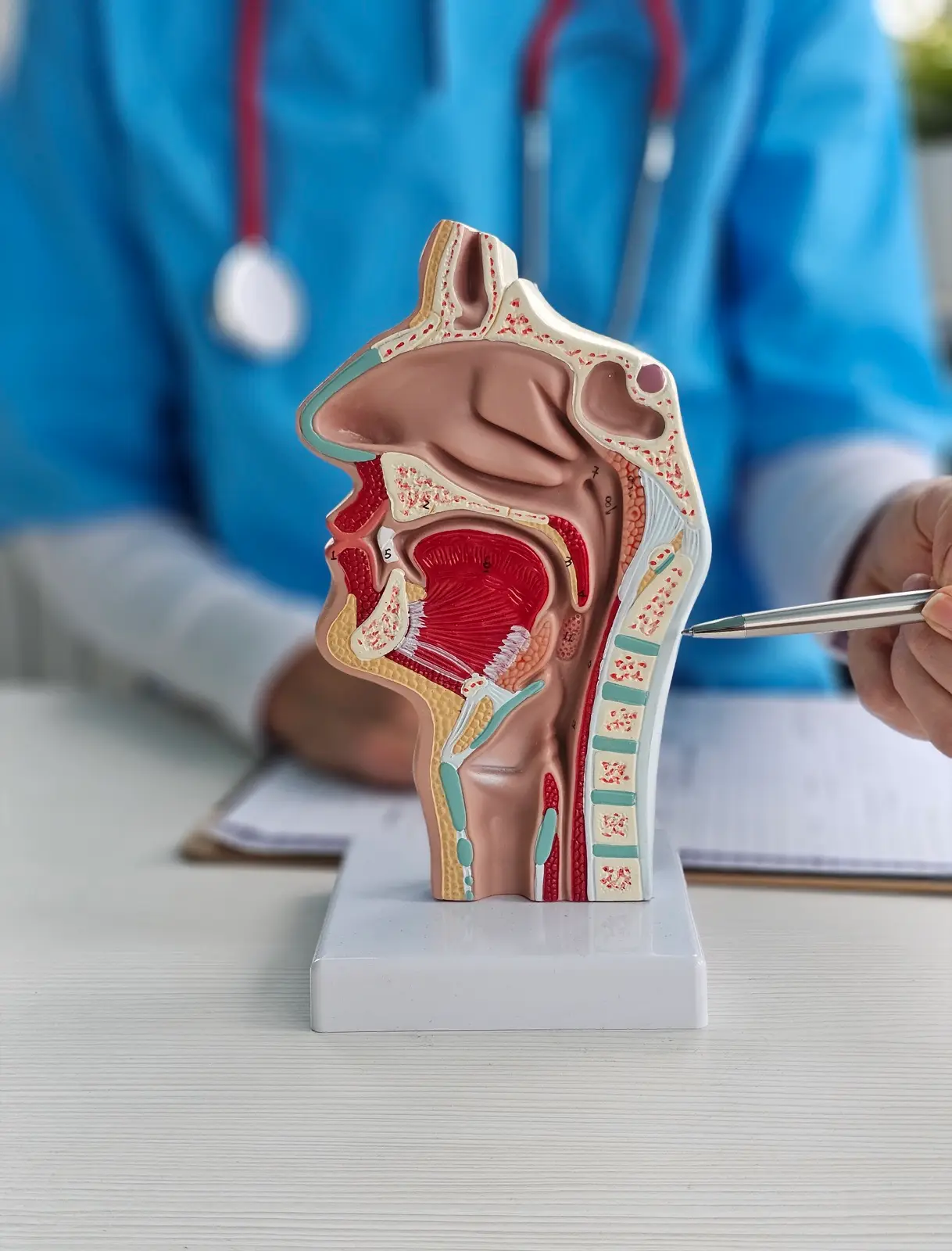
Removing the tonsils, the adenoids or both is a short, routine operation with one unusual feature that matters enormously if you are travelling for it: its main complication does not happen in hospital. Serious bleeding after a tonsillectomy typically arrives around five to ten days later, when the healing scab separates, by which time most international patients have flown home. Everything useful about planning this trip follows from that one fact, so this page starts there rather than with the price.
Istanbul European Clinic Medical Travel Services is a medical travel coordination company in Istanbul: we work with independent partner ENT surgeons who operate at their own clinics or at accredited hospitals. A bilingual coordinator handles your dates, hotel, transfers and interpreting, while every clinical decision, from whether surgery is indicated at all to which technique is used and when you are fit to fly, is made independently by your chosen partner surgeon. Istanbul European Clinic does not perform surgery and does not guarantee outcomes.

An independent partner surgeon checked the medical claims on this page. What applies to your own case is decided by the surgeon who examines you.
What tonsil and adenoid removal costs in Turkey
Market estimates start at about €1,000 and most quotes land between €1,000 and €2,500, depending on whether one operation or both are done. That is a market estimate rather than an Istanbul European Clinic price list, so use it to plan and ask your chosen partner surgeon for a written quote before booking anything.
The number that varies most between quotes is not the surgical fee. It is the length of stay, and on this operation the length of stay is a clinical variable rather than a comfort one.
Three things to get in writing. First, which operation the price assumes: a tonsillectomy, an adenoidectomy or both. Second, how many hotel nights it buys, measured against the bleeding window described in the next section rather than against a package tier. Third, and most often left vague, what happens if you are readmitted: whether a return to theatre, the extra nights and the changed flight sit inside the quote or outside it. A package that is cheap because it is short is not cheaper.
The complication that arrives after you have flown home
Bleeding is the reason tonsillectomy is treated more seriously than its 40 minutes in theatre suggest. Pooled data from 12 randomised trials puts a bleed in the first 24 hours at 1.0% and a bleed after that at 5.8%. The delayed kind is the one that concerns a traveller, and its timing is well described.
| Bleeding measure | Published figure | Source |
|---|---|---|
| Bleed within 24 hours (primary) | 1.0% pooled | 12 randomised trials, 2025 |
| Bleed after 24 hours (secondary) | 5.8% pooled | 12 randomised trials, 2025 |
| Secondary bleed, cold steel technique | 3.7% | 12 randomised trials, 2025 |
| Secondary bleed, bipolar diathermy | 8.6% | 12 randomised trials, 2025 |
| Median day of a severe bleed | Day 6 | 300 emergency cases, 2021 |
| Severe bleeds falling on days 4 to 10 | 66.7% | 300 emergency cases, 2021 |
- The mechanism explains the timing. A clot forms over the raw tonsil bed within a day and thickens over the first week. Around day five to ten the mucosa growing in from the edges lifts that scab away, and if a vessel underneath has not fully healed it bleeds. Nothing has gone wrong with the surgery; this is the normal healing sequence having a bad moment.
- The window is measurable. In 300 patients whose bleeding needed emergency surgery, the median was postoperative day 6, two thirds fell between days 4 and 10, and the latest was day 19. In the same series 64.7% of those emergency operations happened between 6pm and 6am.
- Technique shifts the odds. The pooled trials put secondary bleeding at 3.7% after cold steel dissection and 8.6% after bipolar diathermy. Worth asking which your surgeon uses and why, though the honest caveat is that surgeon familiarity with a technique counts for a great deal too.
- Any bleeding from the mouth or throat is an emergency. Go straight to the nearest emergency department. Do not message the clinic and wait for a reply, and do not wait to see whether it stops. A small bleed that settles on its own is also the most common warning sign before a large one.
This is the part of the operation that medical travel changes. The surgery itself is the same in Istanbul as anywhere. What differs is where you are on day six, and whether the hospital you would walk into that night has your operation note. That is a planning problem with a good solution, and it is only solvable before you travel.
Adults do not recover the way children do
Tonsillectomy has a reputation as a childhood operation, and adults arrive expecting a childhood recovery. The national data says otherwise, on both risk and pain.
| Group | Bleeding measure | Rate |
|---|---|---|
| Children, 0 to 14 | Return to theatre to stop bleeding | 1.16% |
| Adults, 15 and over | Return to theatre to stop bleeding | 3.80% |
| Adults, single-centre series | Any bleeding at all | 21.8% |
| Adults, single-centre series | Needed a second operation | 1.5% |
- Adults are more than three times as likely to need a return to theatre. That is the conclusion of an analysis of 179,172 UK tonsillectomies: 1.16% in children against 3.80% in adults. The absolute risk stays small; the difference between the two groups does not.
- Adult pain lasts 10 to 14 days, not a week, and it commonly peaks around days four to six rather than easing steadily from day one. People who were told to expect a week frequently conclude on day five that something has gone wrong. Usually nothing has.
- Some adult risk factors are modifiable. In a series of 325 adults, current smoking, male sex and perioperative anti-inflammatory painkillers were each independently associated with bleeding. Stopping smoking before surgery and taking only the painkillers your surgeon specifies are small acts with a measurable return.
- Plan the trip for two weeks of being unwell, not one. Not two weeks in Turkey necessarily, but two weeks in which you are not working, not flying on a whim and not somewhere you cannot reach a hospital quickly.
The live version of this page put throat pain at seven to ten days and gave the same recovery picture for everyone. For an adult that is optimistic in a way that produces alarmed patients rather than prepared ones, which is why it has been changed here.
When a tonsillectomy is actually indicated
Not every sore throat leads here, and the threshold is written down. The 2019 American Academy of Otolaryngology guideline sets a documented episode frequency for recurrent throat infection, and is unusually direct about what should happen below it.
- The 7/5/3 threshold. Seven documented episodes in the past year, five per year for two years, or three per year for three years. Below that, the guideline strongly recommends watchful waiting rather than surgery.
- Documented means documented. Each episode needs at least one of a temperature above 38.3°C, cervical adenopathy, tonsillar exudate or a positive test for group A strep. Remembering a bad winter is not the same evidence, and a surgeon who asks for records is applying the guideline rather than being obstructive.
- In adults, surgery works and the benefit has a size. The NATTINA randomised trial in 453 UK adults found a median of 23 sore-throat days over two years after tonsillectomy against 30 with conservative management, with an adjusted incident rate ratio of 0.53. Roughly half the burden, which is a genuine result rather than a cure.
- The same trial priced it honestly. Adverse events related to surgery affected 39% of the operated participants, and bleeding affected 19%. Any decision here is a trade between fewer sore throats over years and a difficult fortnight with a real complication rate.
The reason this matters more when you are travelling is that the threshold is the main thing standing between an appropriate operation and an unnecessary one, and it is the easiest thing to skip when a patient has already booked a flight. A partner surgeon who declines to operate on your history has done you a service, even though it is an expensive one to hear.
In children the usual reason is breathing, not infection
Most childhood adenotonsillectomies are done for obstructed breathing during sleep, not for repeated infections: snoring with pauses, mouth breathing, restless nights and daytime tiredness. The best evidence for it is a randomised trial, and it is more nuanced than the marketing.
- Surgery clearly beats waiting. In the CHAT trial of 464 children aged 5 to 9 with mild to moderate obstructive sleep apnoea, sleep-study findings normalised in 79% of those who had surgery against 46% of those watched and supported.
- But nearly half of the watched children got better anyway. That 46% is the number to hold onto. Some children grow out of it, which is why a surgeon who suggests waiting and reassessing is not fobbing you off.
- The school-performance claim did not hold up. On the trial's main measure of attention and executive function there was no significant difference between the surgery and watchful-waiting groups. Better sleep is a good enough reason on its own; better grades were not demonstrated.
- Adenoids shrink with age. They enlarge through early childhood and usually regress from around seven, so the same child can need the operation at four and not at eight. Timing follows the airway, not the travel calendar.
A clinic that describes adenotonsillectomy as over 95% effective is quoting nothing in particular. The trial figure is 79% normalisation against 46% for doing nothing, and that comparison is far more useful for deciding whether to put a five-year-old on a plane.
Recovery, and the date you fly
- Days 1 to 3Severe sore throat and referred ear pain on swallowing. Cold fluids, pain relief taken on a schedule rather than when it hurts, and as much swallowing as can be managed, which keeps the wound clean. Most patients are discharged the same day or after one night.
- Days 4 to 10Pain typically peaks around days four to six and can feel as though it is going backwards. This is also the window in which a severe bleed is most likely: median day 6, two thirds of cases between days 4 and 10. Stay where an emergency department is quickly reachable.
- Days 10 to 14The scabs separate and the pain settles. Bad breath resolves with them. Children are usually back to school before this point; adults are typically back to normal activity around here.
- Weeks 3 to 6The throat is healed. Where the operation was done for obstructed breathing in a child, snoring and night-time pauses generally improve over these weeks, and the sleep benefit is much easier to judge here than in the first fortnight.
Your return flight date is a clinical decision, not a booking one. Flying on day five puts you in the air, or newly landed somewhere without your surgical records, at the peak of the bleeding window. Some surgeons will clear an earlier flight for a straightforward case in a young child; the point is to ask the question explicitly and to have your operation note, discharge summary and your own emergency department identified before you leave. Our ENT overview sets out how this compares with the other operations in the category.
Sources
Figures on this page that come from published research are listed here with the study they come from, so you can check them yourself.
- Grasl S, et al. Post-tonsillectomy haemorrhage: timing and emergency management. European Archives of Oto-Rhino-Laryngology, 2021;279(3):1601-1607
- Alenezi MM, et al. Post-tonsillectomy haemorrhage rates: systematic review and meta-analysis of 12 RCTs. Clinical Practice, 2025;15(5):85
- Heining C, Clark M. Return to theatre after tonsillectomy: national data. Annals of the Royal College of Surgeons of England, 2024;107(3):206-210
- Inuzuka Y, et al. Risk factors for post-tonsillectomy haemorrhage in adults. Laryngoscope Investigative Otolaryngology, 2020;5(6):1056-1062
- Mitchell RB, et al. Clinical Practice Guideline: Tonsillectomy in Children (Update). Otolaryngology Head and Neck Surgery, 2019;160(1_suppl):S1-S42
- Wilson JA, et al. NATTINA randomised controlled trial: tonsillectomy versus conservative management in adults. The Lancet, 2023;401(10393):2051-2059
- Marcus CL, et al. Childhood Adenotonsillectomy Trial (CHAT). New England Journal of Medicine, 2013;368(25):2366-2376

What we actually do
The travel part is our job
Your surgeon handles the medicine. We handle everything around it: the dates, the hotel, the airport transfers and an interpreter who stays with you at the appointments, so nothing gets lost between languages.
Photo: Engin Yapici / Unsplash
Frequently asked questions
How much does tonsil and adenoid removal cost in Turkey?
Market estimates run from about €1,000, with most quotes falling between €1,000 and €2,500 depending on whether one or both operations are done and where. This is a market estimate rather than an Istanbul European Clinic price list, so treat it as a planning figure and ask your chosen partner surgeon for a written quote before you commit to dates or flights.
What is included in a tonsil surgery package in Turkey?
It varies, which is why it has to be in writing. A typical coordinated package covers the operation, anaesthesia, the hospital stay and airport transfers, with hotel nights arranged around it. Flights are usually separate. The item worth checking specifically is what happens if you bleed after discharge: ask whether readmission, a return to theatre and the extra hotel nights are inside the price or outside it, because that is the complication this operation actually has.
How do medical travel packages bundle hotel and transfers?
Most are built as a fixed number of nights in a partner hotel with airport and clinic transfers included, priced as one figure alongside the surgery. The number of nights is the part to look at rather than the hotel category. For a tonsillectomy the honest question is not how comfortable the hotel is but whether the stay is long enough to cover the days when a bleed is most likely, which the recovery section on this page sets out.
How do I compare tonsil and adenoid removal pricing across clinics?
Compare like for like: which operation is quoted (tonsillectomy, adenoidectomy or both), which surgical technique, how many hospital nights, how many hotel nights, and what happens if a complication brings you back. Two quotes that differ by a few hundred euros usually differ on those lines rather than on surgical quality, and the cheapest quote is often the one with the shortest stay, which is the wrong thing to economise on here.
How do I get a personalised quote for surgery abroad?
Send your history: how many documented throat infections you have had and when, whether the problem is infection or obstructed breathing and snoring, any bleeding disorder or blood-thinning medication, and any previous ENT surgery. A partner surgeon reviews it and confirms whether surgery is appropriate at all before a price is meaningful. A quote issued without any of that information is a price for a procedure, not an answer to your problem.
Is tonsil surgery in Turkey safe?
Tonsillectomy is a routine, high-volume operation and serious harm is uncommon, but it is not a minor procedure and its main complication is bleeding. Pooled data from 12 randomised trials found a 1.0% primary haemorrhage rate (within 24 hours) and a 5.8% secondary haemorrhage rate (after 24 hours). Country is not the variable that decides this. Surgeon volume, technique and, above all, where you are when a delayed bleed happens are.
How likely is bleeding after a tonsillectomy?
The pooled figures from 12 randomised trials are 1.0% for a bleed within the first 24 hours and 5.8% for a bleed after that. Technique matters: the same analysis put secondary bleeding at 3.7% after cold steel dissection and 8.6% after bipolar diathermy. In UK national data, 1.16% of children and 3.80% of adults needed a return to theatre to stop the bleeding, so the risk of the serious version is real but small, and clearly higher in adults.
When is the bleeding risk highest, and what should I do?
Days four to ten. In a study of 300 patients whose bleeding was severe enough to need emergency surgery, the median was postoperative day 6 and 66.7% fell between day 4 and day 10. The scab over the healing tonsil bed separates in that window. Any bleeding from the mouth or throat after a tonsillectomy is an emergency: go to your nearest emergency department immediately rather than messaging the clinic and waiting for a reply. A small bleed can stop on its own and can also be the warning before a large one.
Is a tonsillectomy harder on adults than on children?
Yes, substantially, and this is the most under-communicated fact about the operation. UK national data covering 179,172 tonsillectomies found return-to-theatre rates for bleeding of 1.16% in children against 3.80% in adults, and the authors concluded adults remain more than three times more likely to need one. Adult pain is also worse and lasts longer, typically 10 to 14 days rather than the week children often need. If you are an adult, plan for two weeks, not one.
What is the 7/5/3 rule for tonsillectomy?
It is the episode-frequency threshold for recurrent throat infection used in the 2019 American Academy of Otolaryngology guideline: seven episodes in the past year, five per year for two years, or three per year for three years. Each episode has to be documented with at least one of a temperature above 38.3°C, cervical adenopathy, tonsillar exudate or a positive strep test. Below that threshold the guideline strongly recommends watchful waiting. A surgeon who asks for your documented history before agreeing to operate is applying this; one who does not, is not.
Does a tonsillectomy help adults with recurrent tonsillitis?
It does, and the size of the benefit is worth knowing precisely. The NATTINA randomised trial in 453 UK adults found the tonsillectomy group had a median of 23 sore-throat days over 24 months against 30 in the conservatively managed group, with an adjusted incident rate ratio of 0.53. So roughly half the sore-throat burden. In the same trial, adverse events related to surgery affected 39% of participants and bleeding affected 19%. It works; it is not free.
What age is best to remove adenoids?
There is no single best age. Adenoids grow through early childhood and usually shrink from around age seven, so the decision follows symptoms rather than a birthday: persistent mouth breathing, blocked nasal breathing, snoring with pauses, or recurrent middle-ear problems that have not settled. Many children who would have been operated on at four no longer need it at eight. Your surgeon assesses the airway; the timing question belongs to them, not to a travel schedule.
Can tonsils and adenoids be removed at the same time?
Yes, and in children they very often are, under one anaesthetic. The combined operation is called an adenotonsillectomy and it is the standard approach when the problem is obstructed breathing during sleep, because enlarged tonsils and adenoids usually contribute together. Doing both does not lengthen recovery much beyond a tonsillectomy alone, since the throat pain comes from the tonsil beds.
Does adenotonsillectomy cure sleep apnoea in children?
It helps most children and cures fewer than the marketing suggests. In the CHAT randomised trial of 464 children aged 5 to 9 with mild to moderate obstructive sleep apnoea, sleep-study findings normalised in 79% of the surgery group against 46% of those simply watched. Two things follow. Surgery clearly outperforms waiting, and a meaningful share of children get better without any operation. The trial also found no significant difference between the groups on its main attention and executive-function measure, so improved sleep should not be sold as improved school performance.
How long is recovery after tonsil and adenoid removal?
Children typically need about a week off, adults 10 to 14 days. Expect a severe sore throat, referred ear pain when swallowing, bad breath from the healing scabs, and a period around days four to six when the pain is at its worst and often feels like it is going backwards. That is normal. Eating and drinking through it, unappealing as it is, keeps the wound clean and is part of the treatment rather than optional advice.
When is it safe to fly home after tonsil surgery?
That is a decision for your surgeon and it is the single most important date on your trip. The reason is timing: severe bleeds cluster on days four to ten, with a median of day 6. Flying home on day five means being in the air, or newly arrived somewhere without your surgical records, during the peak of the risk window. Some surgeons will clear an earlier flight for a straightforward case; the point is to have that conversation explicitly rather than book the return leg around a package length.
How do I verify a clinic and surgeon before travelling?
Ask for the surgeon's name and Turkish Ministry of Health registration and check it independently, ask how many tonsillectomies they perform a year and by which technique, and ask which hospital you would be admitted to if you needed a return to theatre. Independent reviews are worth reading for logistics but tell you little about surgical safety. Istanbul European Clinic introduces independent partner ENT surgeons and does not employ them, so verifying them yourself is reasonable and expected, not a discourtesy.
How are complications handled once I am home?
Realistically, by your own health service, and you should plan on that basis. A bleed on day six needs a hospital that can take you to theatre within the hour, and that hospital will be near you, not in Istanbul. Before you travel, know your nearest emergency department, keep your operation note and discharge summary where you can hand them over, and tell your GP the surgery is happening. Your partner surgeon can advise remotely and send records; they cannot treat a haemorrhage from another country.