
Plastic surgery · coordinated in Istanbul
Tummy tuck in Turkey
A tummy tuck, or abdominoplasty, cuts away the loose skin of the lower abdomen, repairs the abdominal muscles if pregnancy or weight loss has separated them, and repositions the navel. That makes it a fundamentally different operation from liposuction, which removes fat and leaves the skin and the muscle exactly as they were. It is also a bigger one: a long permanent scar, drains, and a recovery measured in weeks rather than days.
Istanbul European Clinic Medical Travel Services is a medical travel coordination company in Istanbul: we work with independent partner plastic surgeons who operate at their own clinics or at accredited hospitals. A bilingual coordinator handles your dates, hotel, transfers and interpreting, while every clinical decision, from whether a tummy tuck is the right operation to whether it should be a full or a mini, is made independently by your chosen partner surgeon. Istanbul European Clinic does not perform surgery and does not guarantee outcomes.


An independent partner surgeon checked the medical claims on this page. What applies to your own case is decided by the surgeon who examines you.
Last reviewed 16 September 2026How much does a tummy tuck cost in Turkey?
An abdominoplasty coordinated through our partner surgeons starts from €3,150. The variable that makes tummy tuck quotes hard to compare is not the currency, it is whether the price is for a full or a mini abdominoplasty, and whether muscle repair is included at all.
| Where | Published cost | What the figure covers |
|---|---|---|
| Turkey, partner surgeons | from €3,150 | Surgery, anaesthesia, hospital stay, transfers. A starting figure; a full abdominoplasty with combined liposuction is more |
| United Kingdom, national range | £6,701 – £11,931 | Self-pay charges across 48 providers, collected May 2025 by GoPrivate.com. Usually consultant and hospital fees; may exclude tests and post-operative care |
| Harley Medical Group, list price | £9,995 full, £7,995 mini | Published UK price list. Full abdominoplasty with liposuction to one area is listed at £11,995 |
| Cadogan Clinic, London list price | £7,295 mini, £10,995 with liposuction | Published London list: mini abdominoplasty, and a Brazilian abdominoplasty with two-area liposuction |
Notice that the cheapest published UK figures are for the mini abdominoplasty, which is a smaller operation on a smaller area. That is the comparison trap on this procedure in every country: a lower price often means less operation, not a discount on the same one. Ask any quote you receive to state, in writing, whether it is full or mini, whether repair of the muscle separation is included, and how many areas of liposuction come with it.
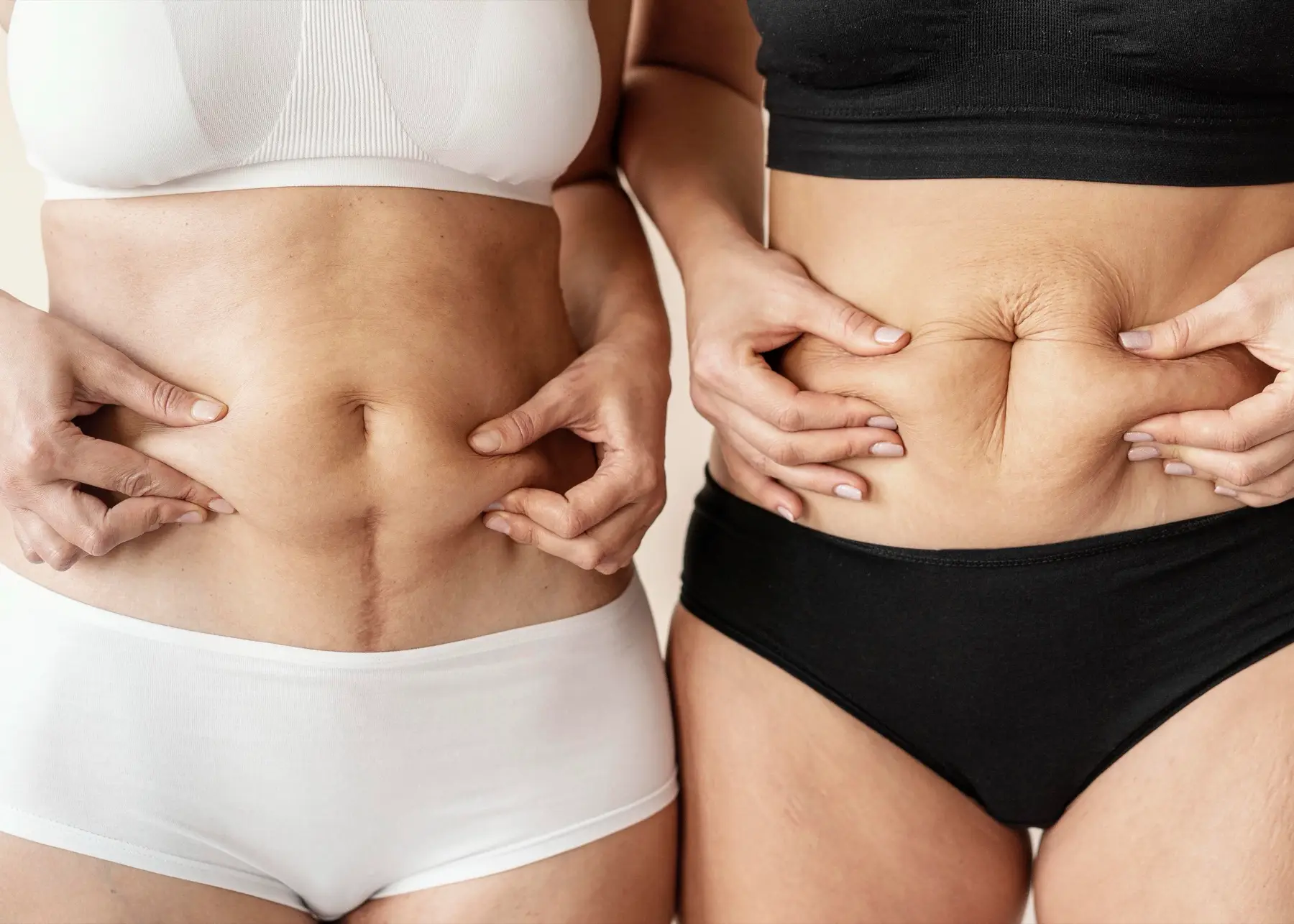
A tummy tuck is not a bigger liposuction
If you are choosing between these two, this is the section that matters. They are marketed as two strengths of the same treatment and they are not the same treatment. They fix different problems, and picking the wrong one is the most common way people end up disappointed by an operation that went technically perfectly.
| Tummy tuck (abdominoplasty) | Liposuction | |
|---|---|---|
| Excess skin | Cut away and the remaining skin redraped | Not removed. Skin is left to retract on its own, and if it cannot, it stays loose |
| Separated abdominal muscle | Repaired: the muscles are stitched back together | Not addressed at all. Liposuction does nothing to the muscle layer |
| Fat | Removed, usually with liposuction during the same operation | The whole point of the operation |
| Scar | Long and permanent, low across the abdomen roughly hip to hip, plus one around the navel | A few marks of a few millimetres |
| Recovery | Weeks. Drains, a compression garment, no lifting, and moving carefully at first | Days to a couple of weeks for desk work |
- Pregnancy and major weight loss stretch skin past the point where it retracts. Once that has happened, removing the fat underneath it with liposuction can leave the abdomen looser than it was. No device, technique or brand name changes this, and a provider offering to fix loose skin with liposuction is either mistaken or selling.
- Diastasis recti is a muscle problem, not a fat problem. When the two vertical abdominal muscles separate during pregnancy, the abdomen stays rounded no matter how little fat is left. Only the surgical repair in an abdominoplasty closes that gap.
- If your skin is still elastic and the issue is a localised pocket of fat, then liposuction is the right, smaller, cheaper operation and a tummy tuck would be overtreatment. The distinction cuts both ways, which is why it needs a proper assessment rather than a price list.
The two are frequently combined, because they solve different halves of the same complaint. What you should not accept is being steered toward the cheaper operation when the assessment points at the other one.
The safety data, with the actual numbers
This is major abdominal surgery, and the published record is reassuring in a way that deserves stating precisely rather than vaguely. A study of 29,235 patients having abdominoplasty combined with breast surgery reported a major complication rate of 1.12% in the acute period after surgery, venous thromboembolism at 0.1%, and no deaths in the series. It also concluded that combining the two procedures carried complication rates equivalent to performing them separately.
- Venous thromboembolism is the risk to respect. At 0.1% it is uncommon, but it is the one this operation actually drives, because a long procedure plus days of reduced movement is exactly the condition a clot forms in. It is managed by honest patient selection, clot-prevention measures during surgery, and getting you walking early. Declare every condition and every medication at your assessment, particularly anything affecting clotting.
- Then add a flight to that. Sitting still for hours pushes on the same risk the operation already raises. This is the reason your surgeon, not your airline booking, sets the date you fly home, and the reason compression stockings and walking the cabin are instructions rather than suggestions.
- The reassurance is conditional, not universal. Those figures come from properly selected patients operated on by teams that manage long anaesthetic times well. They describe what this operation can be, not a promise that attaches to whoever performs it.
- The common complications are not the dangerous ones. Seroma (fluid collecting under the skin), wound-healing problems at the incision, numbness above the scar and scar revision are all reasonably frequent and are nuisances rather than emergencies. Sudden breathlessness, chest pain or a swollen painful calf are emergencies, and they need a hospital the same day, wherever in the world you are.
The honest summary: for the right patient and the right team, this is a well-documented operation with a low rate of serious harm. The entire safety margin sits in the words "right patient and right team", which is why the assessment matters more than the price.
It is usually done with liposuction, so the liposuction risks apply too
Most tummy tucks include liposuction of the flanks and waist in the same operation, which means the safety record of liposuction becomes part of your risk picture. That record is more sobering than the abdominoplasty data above, and it is worth knowing before you compare packages.
A review in Plastic and Reconstructive Surgery of major and lethal liposuction complications in Germany between 1998 and 2002 documented 72 serious complications and 23 deaths over five years. The most frequent lethal causes were bacterial infections such as necrotising fasciitis, gas gangrene and sepsis, followed by haemorrhage, perforation of abdominal organs and pulmonary embolism.
- 57 of the 72 complications were clinically evident within the first 24 postoperative hours. That is the single most useful fact on this page for anyone travelling: the dangerous window is short, and it falls exactly where a cheap package is tempted to save money.
- Permissive postoperative discharge is one of the risk factors the authors named. Sending patients back to a hotel too early. Take the 1 to 3 nights your surgeon recommends rather than the shortest stay offered to you.
- Insufficient standards of hygiene is another, and given that infection was the leading lethal cause, it is the one to ask about first. Ask which hospital or licensed facility the operation takes place in, by name, and check it yourself.
- Selection of unfit patients, and lack of surgical experience, complete the list. Both are answerable questions: is my weight stable enough for this to be the right time, and who exactly is operating?
- Combining adds operating time, and operating time is what drives the clot risk. That is why what gets combined should be a clinical judgement about your health, not a package tier chosen from a menu.
The scar, and the other things nobody puts in the brochure
- The scar is permanent and it is long. A full abdominoplasty leaves a horizontal scar running low across the abdomen, roughly hip to hip, placed so that underwear or a swimming costume covers it, plus a small one around the navel. It fades over about a year from red toward a pale line. It does not disappear. This is the trade you are making for the loose skin, and it should be shown to you honestly at the consultation.
- You will have drains, usually for the first days. Small tubes that let fluid out while the tissue settles. They are removed at a follow-up appointment, which is one reason the stay in Turkey is 7 to 10 days rather than three.
- You will not stand up straight at first. Because the abdominal skin has been tightened, you move slightly bent forward for the first days and straighten up gradually. It is expected, not a complication.
- Numbness above the scar is common and can be long-lasting. Sensation over the lower abdomen usually returns partially and sometimes not entirely.
- No lifting for weeks, and that includes children. If you cannot arrange help at home for that period, the timing is wrong even if you are a good candidate.
Who is a realistic candidate
- Loose skin, not just fat. Skin that has been stretched by pregnancy or significant weight loss and will not retract, with or without separated abdominal muscles. If the skin is still elastic, read the comparison section again.
- Finished having children. A later pregnancy stretches the muscle repair again and undoes much of the result. This is usually the first question a good surgeon asks.
- Stable weight. Not mid-way through losing weight. Operating on a body that is still changing produces a result that will also change, and a higher BMI raises the risk of wound-healing problems and clots.
- Non-smoker. Nicotine constricts the blood supply the healing incision depends on, and wound-healing problems along a long scar are the complication it causes. Surgeons routinely require you to stop well before surgery.
- Honest about your health. Clotting disorders, heart and lung conditions, diabetes and hormonal contraception all change the calculation for a long operation followed by a flight. Declare all of it.
- Able to arrange several weeks of help. No lifting, limited movement, and drains at first. This is the constraint people most often underestimate.
A partner surgeon may recommend a mini rather than a full abdominoplasty, may ask you to lose weight first, or may decline. That judgement is a large part of what you are choosing a surgeon for.
Recovery, honestly
Recovery from an abdominoplasty is longer and more demanding than from liposuction, because skin has been excised and muscle has been repaired. The timeline below is the normal course, not a complication.
- First 24 hoursYou stay in hospital. This is the window the published complication data concentrates in, so report fever, spreading redness, breathlessness, chest pain or calf pain immediately rather than waiting to see how it develops. You will be helped up and walking sooner than you expect, because early movement is what keeps the clot risk down.
- Week 1The hardest week. Tightness rather than sharp pain, managed with prescribed medication. Drains for the first days, a compression garment, and moving slightly bent forward. Short frequent walks. Rest at the hotel after discharge, with a final check before you fly.
- Weeks 2 to 3Swelling and bruising reduce noticeably and you straighten up. Most people return to desk work in this window. Still no lifting, no strenuous activity, and no lifting children. Flying is usually cleared around 7 to 10 days after surgery, by your surgeon rather than by your ticket.
- Weeks 4 to 6Gradually more mobile, with light activity resuming on your surgeon's schedule. The scar is at its most obvious now, red and raised, which is the normal stage rather than a sign something is wrong.
- Months 3 to 12The result settles as the last swelling resolves and the scar fades from red toward pale. Judge the abdomen at the far end of this window, not before, and expect the scar to keep improving past 12 months.
Plan 7 to 10 days in Turkey and, just as importantly, plan the weeks that follow at home. Arrange help with lifting and with children before you travel. On the flight: compression stockings, water, no alcohol, walk the cabin, and only on a date your surgeon has cleared.
Sources
Figures on this page that come from published research are listed here with the study they come from, so you can check them yourself.
What we actually do
The travel part is our job
Your surgeon handles the medicine. We handle everything around it: the dates, the hotel, the airport transfers and an interpreter who stays with you at the appointments, so nothing gets lost between languages.
Photo: Engin Yapici / Unsplash
Frequently asked questions
What is the best age for a tummy tuck?
There is no ideal age. What matters is that your weight is stable, your general health is good, you have finished having children, and your expectations are realistic. A 30-year-old planning another pregnancy is a worse candidate than a 55-year-old whose weight has been steady for years.
Can you trust surgery in Turkey?
Trust the specifics rather than the country. Ask which hospital the operation takes place in, the name of the operating surgeon, how many nights you stay, and what happens if a complication develops after you fly home. A provider who answers those in writing has told you more than any testimonial.
Which country is best for tummy tuck surgery?
There is no best country, only a better or worse combination of surgeon, facility and aftercare. Turkey is usually chosen on price, and the UK or western Europe on proximity to your own follow-up care. The honest trade-off is that travelling saves money and puts distance between you and the person who operated on you, and a tummy tuck involves drains, a long incision and a recovery measured in weeks.
What causes loose belly skin?
Pregnancy, significant weight loss and ageing stretch the skin beyond what it can retract from, and the abdominal muscles can separate at the same time. Once skin has lost that elasticity it does not tighten with exercise, and it does not tighten when the fat underneath is removed either. That is precisely why liposuction alone does not fix it.
How can I verify credentials and safety standards when booking an online clinic visit?
Ask for the operating surgeon's full name and check their specialty registration yourself. Ask which hospital or clinic is used and check that facility, not the brand booking it. Ask whether the consultation is with the surgeon who will actually operate. Then ask for the plan in writing, including whether it is a full or a mini abdominoplasty, whether muscle repair is included, and how many nights you stay in hospital.
Are there reputable clinics in Turkey for abdominoplasty?
Yes, and the range of quality is wide, which is exactly why the choice matters. Istanbul European Clinic Medical Travel Services works with independent partner plastic surgeons who operate at their own clinics or at accredited hospitals: we coordinate the travel, and the surgeon carries clinical responsibility. Ask for the specific facility and the specific surgeon before you commit to a date.
What is an hourglass tummy tuck?
A marketing name for an abdominoplasty combined with liposuction of the waist and flanks, so that the waist narrows as well as the abdomen flattening. There is no separate operation behind the name. Ask which procedures are actually included and whether muscle repair is part of it, and price it on that rather than on the label.
How much does an hourglass tummy tuck cost?
More than a standard abdominoplasty, because it adds liposuction areas and operating time. Ask for the combination itemised rather than accepting one figure. For a UK reference point, Cadogan Clinic in London publishes its equivalent, a Brazilian abdominoplasty with two-area liposuction, at £10,995.
What is tummy tuck surgery?
An abdominoplasty removes the excess skin of the lower abdomen through a long incision above the pubic area, repairs the abdominal muscles if they have separated, and repositions the navel. It is not primarily a fat-removal operation, although liposuction is usually done at the same time. The skin excision and the muscle repair are what separate it from liposuction, and they are why it leaves a long permanent scar.
How do I choose the right clinic for a tummy tuck in Turkey?
Judge on the answers you get rather than on the photographs. Which hospital, which surgeon, full or mini, is muscle repair included, how many nights in hospital, when do the drains come out, when can I fly, and what happens if there is a problem once I am home. Clear written answers to those tell you what you need to know.
Are results from a tummy tuck in Turkey natural-looking?
A well-planned tummy tuck gives a flatter, firmer abdomen in proportion to the rest of you. What it cannot do is hide the scar, which is permanent. Judge the result at 6 to 12 months, once the swelling has resolved and the scar has faded from red toward pale.
What happens if complications occur after I return home?
See a local doctor or go to an emergency department promptly rather than waiting for a reply from abroad, and take a copy of your operative notes, which is why you should ask for them before you fly. Sudden breathlessness, chest pain or a swollen painful calf are emergencies: venous thromboembolism is the serious risk this operation carries. Istanbul European Clinic is a coordination company and does not provide medical care.
Is it safe to fly after tummy tuck surgery?
Once your surgeon has cleared you, which is usually around 7 to 10 days after surgery. That clearance should follow your final check rather than a ticket bought in advance. On the flight, wear compression stockings, drink water, avoid alcohol and walk the cabin regularly, because immobility is what drives the clot risk.
Can tummy tuck results be permanent?
The skin that was removed does not come back and the muscle repair is durable, so largely yes. Two things undo it: significant weight change, and a later pregnancy, which stretches the repair again. That is why a surgeon will ask whether you have finished having children before agreeing to operate.
When can I return to work after a tummy tuck?
Around 2 to 3 weeks for desk work, and longer if your job involves lifting or standing all day. Expect to move carefully and slightly bent forward for the first days, and to avoid lifting anything heavy, including small children, for several weeks.
Will I have visible scars after a tummy tuck?
Yes, and this is the honest trade-off of the operation. A full tummy tuck leaves a long horizontal scar running low across the abdomen, roughly hip to hip, positioned so that underwear or a swimming costume covers it, and there is usually a second small scar around the navel. It is permanent. It fades over about 12 months from red toward a pale line, but it does not disappear, and anyone who tells you it will is selling.
How long does it take to see final tummy tuck results?
You will see a flatter abdomen within weeks, but the swelling takes months to resolve completely. The settled result is at 6 to 12 months, and the scar keeps fading past that point.
How painful is tummy tuck recovery?
The first week is genuinely uncomfortable, and more so than after liposuction, because the muscle repair is the part that hurts. It is managed with prescribed medication and improves steadily. You may have drains for the first days, and you will wear a compression garment.
Can plus-size patients have a tummy tuck in Turkey?
It depends on the individual. A higher BMI raises the risk of wound-healing problems and of clots, and most surgeons want your weight stable first, because operating on someone who is still actively losing weight produces a result that will change. A surgeon who defers or declines is reading your case, not turning away business.
Is a tummy tuck in Turkey suitable for men?
Yes. Men most often have it after major weight loss, where the problem is identical: skin that will not retract. The planning differs, because the scar position and the shape being aimed at are different, but the operation and its risks are the same.
Can tummy tuck surgery in Turkey be combined with liposuction?
Yes, and it usually is, because the two do different jobs: liposuction reduces the fat of the flanks and waist, while the tummy tuck removes the loose skin and repairs the muscle. Combining adds operating time, and operating time is what drives the clot risk, so it is a clinical decision made on your health rather than a package tier.
What is the difference between a full and mini tummy tuck?
A mini tummy tuck treats only the area below the navel, uses a shorter incision, does not usually move the navel, and generally does not include repair of muscle separation above it. A full tummy tuck treats the whole abdominal wall and does. A mini is a smaller operation with a smaller scar and a shorter recovery, and it is the right choice only if your looseness is genuinely confined to below the navel. Being sold a mini because it is cheaper is a common route to disappointment.
How long do I need to stay in Turkey for a tummy tuck?
Plan 7 to 10 days: the operation, 1 to 3 nights in hospital, drain removal, and a final check before you are cleared to fly.
What is included in an all-inclusive tummy tuck package in Turkey?
Typically the surgery, anaesthesia, the hospital stay, pre-op tests, medication, a compression garment, airport transfers and hotel accommodation. Flights are usually not included. Ask specifically whether the quote is for a full or a mini abdominoplasty and whether muscle repair is included, because those change both the price and the result.
Why is a tummy tuck cheaper in Turkey compared to other countries?
Local salaries, facility costs and the exchange rate. That accounts for the difference between Turkey and the UK. It does not account for a clinic priced far below other clinics in Turkey, and that is the gap worth asking about.
How much is a tummy tuck in Turkey?
Coordinated through our partner surgeons it starts from €3,150, which normally covers the surgery, the hospital stay, hotel accommodation and airport transfers. In the UK, GoPrivate.com lists self-pay abdominoplasty at £6,701 to £11,931 nationally across 48 providers (prices collected May 2025), and the Harley Medical Group publishes £9,995 for a full abdominoplasty and £7,995 for a mini. What moves the Turkish price is whether it is a full or a mini tummy tuck, and how much liposuction is combined with it.
Is it safe to have a tummy tuck in Turkey?
The operation has a good published safety record. In a study of 29,235 patients having abdominoplasty combined with breast surgery, the major complication rate in the acute period was 1.12%, venous thromboembolism was 0.1%, and there were no deaths in the series. What that data assumes is a properly selected patient, a proper facility and a team that manages a long operation well. Those are things you verify about a specific clinic; they are not guaranteed by a country.