
Eye surgery · coordinated in Istanbul
SMILE eye surgery in Turkey
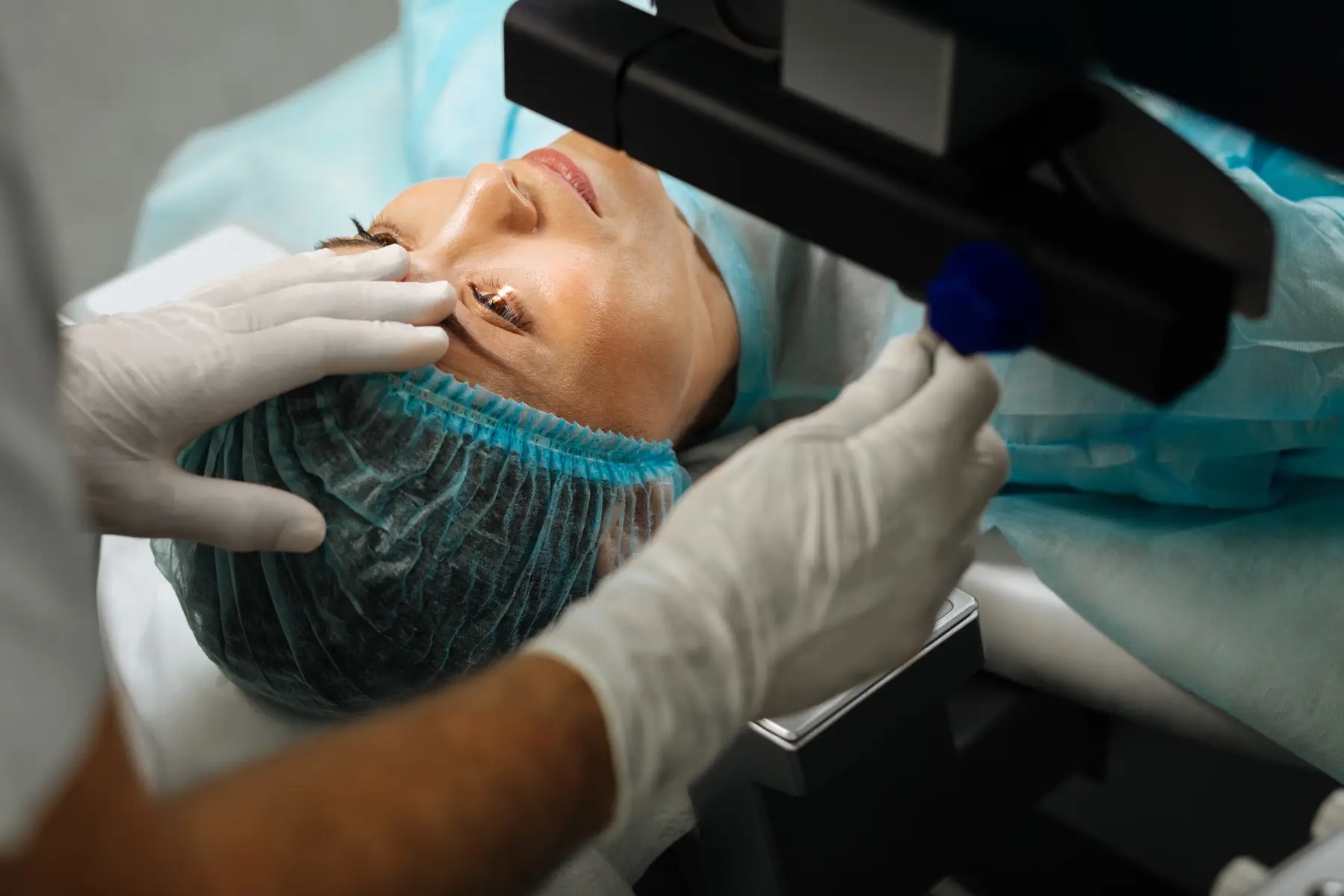
SMILE, short for small incision lenticule extraction, corrects short-sightedness and astigmatism by reshaping the cornea from the inside. A femtosecond laser carves a small disc of tissue, called a lenticule, within the cornea, and the surgeon removes it through a small incision. There is no corneal flap, which is the single fact that most of its advantages, and most of its limits, come back to.
Istanbul European Clinic Medical Travel Services is a medical travel coordination company in Istanbul: we work with independent partner ophthalmologists who treat you at their own clinics or at accredited hospitals. A bilingual coordinator handles your dates, hotel, transfers and interpreting, while every clinical decision, including whether SMILE suits your prescription at all, is made independently by your chosen partner eye surgeon. Istanbul European Clinic does not perform surgery and does not guarantee outcomes.

An independent partner surgeon checked the medical claims on this page. What applies to your own case is decided by the surgeon who examines you.
Last reviewed 15 September 2026How much does SMILE cost in Turkey?
Istanbul European Clinic does not sell eye surgery from a fixed price list, so the figures here are a market estimate for SMILE in Turkey, not a quote from us. As a market range, both eyes start from about €2,390, which is typically a little more than LASIK, because SMILE runs on newer and costlier laser hardware. Use the numbers to read the market, then get a written quote after a corneal scan.
| Where | Both eyes | What that figure is |
|---|---|---|
| Turkey, market estimate | from €2,390 | A market range, not an Istanbul European Clinic quote. SMILE usually costs a little more than LASIK |
| United Kingdom | around €2,500 per eye | A per-eye price for laser vision correction generally; SMILE tends to sit at the top of the UK range |
The same two cautions as any laser eye surgery apply. These are market estimates, because eye surgery is not on Istanbul European Clinic's price list, so only a written quote after a corneal assessment means anything for your eyes. And confirm whether a figure is per eye or for both, since that alone can appear to halve or double a price.
What SMILE actually is, and its real advantage
The genuine case for SMILE is not a success percentage a clinic invents; it is what removing the flap changes. In the 2024 Cureus comparison, around 90% to 95% of SMILE patients reached 20/20 uncorrected vision within the first day. That is the sourced figure. The live version of this page claimed a flat "96%" with no source, and we removed it.
The advantage that follows from having no flap is twofold, and both parts are real rather than marketing.
- Less dry eye. LASIK lifts a flap, which cuts more of the corneal nerves that drive tear production; SMILE reaches the cornea through a small incision and disturbs fewer of them. Because dry eye is the most common complication of LASIK, affecting most patients to some degree, this is the difference people notice most.
- No flap to dislodge. There is no corneal flap that a future blow to the eye could displace, so the small long-term trauma risk that comes with a LASIK flap does not apply.
- Corneal strength is better preserved. Working through a small incision rather than a flap keeps more of the cornea structurally intact, which is part of why it appeals for thinner corneas and contact-sport players.
These are concrete, mechanical advantages, and they are the honest reasons to consider SMILE. They are not the same as it being the right procedure for you, which is what the next two sections are about.
The real limits: newer, and not for every prescription
Newer is not automatically better, and the two honest limits of SMILE both come from what it is: a more recent technique with a narrower range. A page that only lists advantages is selling a name.
- A narrower prescription range. SMILE is used mainly for short-sightedness and astigmatism. For long-sightedness (hyperopia), and often for very low prescriptions, LASIK or the surface procedure PRK is usually the more suitable choice. This is a clinical boundary, not a preference.
- Less very-long-term data. LASIK has decades of follow-up behind it. SMILE is well established and studied, but the body of very-long-term evidence is smaller simply because it is younger. That is worth knowing, not fearing.
- Enhancement is handled differently. If a touch-up is ever needed, retreating a SMILE eye is approached differently from retreating a LASIK eye. It is a question worth asking your surgeon directly rather than assuming.
The takeaway is not that SMILE is worse. It is that "the newest one" is the wrong way to choose. The right procedure is the one that fits your cornea and your prescription, and for some eyes that is SMILE and for others it is plainly LASIK.
SMILE or LASIK? An honest comparison
This is the question the two pages exist to answer together, so here it is straight, with neither procedure flattered. Both correct vision well; they trade different strengths, and the decision belongs to the surgeon who examines your eye, not to whichever name sounds more advanced.
| SMILE | LASIK | |
|---|---|---|
| Corneal flap | None; small incision | Yes, a hinged flap |
| Dry eye | Less common | The most common complication |
| Prescription range | Mainly short-sightedness and astigmatism | Wider, including long-sightedness |
| Long-term data | Smaller, newer technique | Decades of follow-up |
| Typical cost | A little higher | Usually the cheaper option |
Read across the row that matters most for you rather than counting ticks. If you have dry eyes or play contact sport, the flapless column earns its slightly higher price. If your prescription is outside SMILE's range, or cost is decisive, LASIK is not a downgrade, it is the better fit. Your partner eye surgeon settles it with your scans in front of them, and a clinic that pushes one technique for every patient is answering a different question from yours.
Who is a realistic candidate
SMILE has its own eligibility rules, and they are stricter on prescription type than LASIK. The corneal scan settles it, but here is what it is checking.
- Short-sightedness, with or without astigmatism, broadly in the moderate range, is the core use. Long-sightedness is generally not a SMILE case.
- A prescription stable for at least 12 months. As with any laser correction, a moving prescription is a reason to wait.
- Enough corneal thickness and a regular cornea. Confirmed on a topography scan; keratoconus and other corneal disease rule it out.
- Usually 22 or older, for the extra prescription stability that age tends to bring.
- No active autoimmune disease or history of severe eye infection, both of which affect healing and are things to declare honestly.
If a surgeon looks at your scan and recommends LASIK or PRK instead of SMILE, that is the assessment doing its job. The aim is the procedure that fits your eye, not the one you arrived asking for.
The recovery timeline
SMILE recovery is quick, helped by the small incision, though vision can take a few days to sharpen fully rather than clearing overnight. This is the usual shape of it.
- First 24 – 48 hoursVision is functional but can be hazy, and the eye may water and feel gritty. Rest, use the drops, and do not rub. Most people are cleared to fly once the surgeon has checked the eye, often within a day or two.
- Week 1Vision becomes usable for most daily tasks, with some fluctuation. Keep using the prescribed drops and wear sunglasses outdoors to protect the healing surface.
- Week 3Most people feel fully recovered and can resume moderate exercise and eye make-up. Night-time halos or glare, if present, usually begin to fade.
- Months 3 to 6Vision stabilises fully and any residual dryness usually resolves. This is when the final result is best judged.
- Year 1 and beyondThe eye is considered fully healed, and long-term regression is uncommon. A routine annual eye exam remains worth keeping.
Plan the trip around the post-operative check, not the return flight you would prefer. Cabin air is drying, so carry preservative-free drops for the plane, and do not book the flight home for the day of surgery.
Sources
Figures on this page that come from published research are listed here with the study they come from, so you can check them yourself.

What we actually do
The travel part is our job
Your surgeon handles the medicine. We handle everything around it: the dates, the hotel, the airport transfers and an interpreter who stays with you at the appointments, so nothing gets lost between languages.
Photo: Engin Yapici / Unsplash
Frequently asked questions
What is smile eye surgery?
SMILE stands for small incision lenticule extraction. It corrects short-sightedness and astigmatism by using a femtosecond laser to form a small piece of tissue, the lenticule, within the cornea, which the surgeon then removes through a small incision to reshape the eye. Unlike LASIK, no corneal flap is created.
Smile eye surgery what is it?
SMILE, or small incision lenticule extraction, is a laser vision correction procedure. A femtosecond laser shapes a small disc of tissue, the lenticule, inside the cornea, and the surgeon removes it through a small incision to reshape the eye. There is no corneal flap, and it corrects short-sightedness and astigmatism with a quick recovery.
Is SMILE really better than LASIK?
Better depends entirely on the eye. SMILE is flapless, tends to cause less dry eye and leaves the cornea biomechanically stronger, which can matter for contact-sport players or thinner corneas. LASIK treats a wider range of prescriptions, including long-sightedness, and has more long-term data behind it. In the Cureus 2024 comparison, around 90% to 95% of SMILE patients reached 20/20 within the first day. The right choice is the one your surgeon reaches after examining your cornea and prescription, not the newer name.
What is the disadvantage of SMILE surgery?
Two things stand out. It treats a narrower range than LASIK: it is used mainly for short-sightedness and astigmatism, and is generally not the first choice for long-sightedness or very low prescriptions. And it is a newer technique, so there is less very-long-term data behind it than behind LASIK. Neither makes it worse, but both mean newest is not automatically best for your eyes.
Is Lasik 100% successful?
No procedure is 100% successful or risk-free. Laser vision correction has high success rates, but there is always a small chance of complications or of needing a touch-up. Any clinic promising a guaranteed perfect result is overpromising.
How long does smile eye surgery last?
The correction is intended to be permanent, because the cornea is physically reshaped. Age-related changes such as presbyopia, the need for reading glasses from around your mid-forties, can still affect your vision later, but that is normal ageing rather than the SMILE result regressing.
What is smile pro eye surgery?
SMILE Pro is the name for a faster version of the procedure on newer laser hardware, which cuts the laser time to a handful of seconds per eye for added comfort. The underlying technique, a lenticule removed through a small incision with no flap, is the same.
How much is smile eye surgery?
As a market estimate, roughly €2,390 to €2,550 for both eyes in Turkey, a little more than LASIK. These are market figures rather than an Istanbul European Clinic price; packages often add transfers and accommodation, so ask for a written quote stating exactly what is included.
How much does smile eye surgery cost?
In Turkey the market estimate is around €2,390 to €2,550 for both eyes, which is typically higher than LASIK and lower than Western European prices. Because SMILE is quoted case by case after a corneal assessment, treat any figure as an estimate until you have a written quote.
How do I compare Smile Eye Surgery pricing across clinics?
Compare like for like. Check whether the price is per eye or for both eyes, and whether it includes the corneal scans, the post-operative drops and any follow-up. Very low prices often leave these out. Because SMILE is quoted case by case, the figures on this page are market estimates rather than an Istanbul European Clinic price; a written quote that lists what it covers is the only one worth comparing.
What are common risks of long flights after Smile Eye Surgery and how can you mitigate them?
The main issue is dry cabin air aggravating the temporary dryness that follows any laser eye surgery. Flying is generally fine once your surgeon has cleared you, often within a day or two. Use preservative-free lubricating drops regularly during the flight and a sleep mask if you doze, so your eyes do not dry out further.
How do clinics handle complications if they occur after returning home?
A reputable partner clinic provides remote aftercare by phone or video and a detailed medical report for your local eye doctor before you leave. If a touch-up is needed, some clinics offer it at reduced or no cost, though the travel back is usually your own expense. Agree what happens in that situation before you travel.
Where can I get all-inclusive packages for Smile Eye Surgery with hotel and transfers?
Many Istanbul clinics and coordinators offer packages combining the procedure with a hotel stay and transfers. Istanbul European Clinic Medical Travel Services arranges that travel side, the dates, hotel, transfers and interpreting, around the independent partner ophthalmologist you choose, rather than performing the surgery itself. Ask for the contents in writing so nothing essential is assumed.
How can international patients compare accredited clinics for Smile Eye Surgery abroad?
Compare the laser platform used, the surgeon's specific experience with SMILE rather than LASIK alone, and how transparent the pricing is. Ask for a written breakdown of what the package includes, and confirm any accreditation on the issuing body's own database.
How can I verify clinic accreditations and patient reviews before traveling for surgery?
Check accreditation such as JCI or Turkish Ministry of Health certification on the issuing body's own records rather than a badge on the clinic site, and read reviews on independent platforms. Ask to see outcomes for patients with a prescription like yours, and treat curated before-and-after material with due caution.
What are the safest ways to arrange a medical trip for Smile Eye Surgery in Turkey?
Either book directly with an accredited clinic or work through a coordinator that is clear about its role. Istanbul European Clinic Medical Travel Services is a coordination company: we arrange travel, accommodation, transfers and interpreting and introduce you to independent partner ophthalmologists who assess your case and carry clinical responsibility for it. We do not perform surgery or employ the surgeons. Whichever route you choose, insist on a full corneal assessment first, since SMILE does not suit every prescription.