
Article
Body Contouring: Which Procedure Solves Which Problem
An independent partner surgeon checked the medical claims on this page. What applies to your own case is decided by the surgeon who examines you.
Written by the editorial team, not by a clinician. Nothing here is medical advice: your independent partner surgeon decides what applies to you.
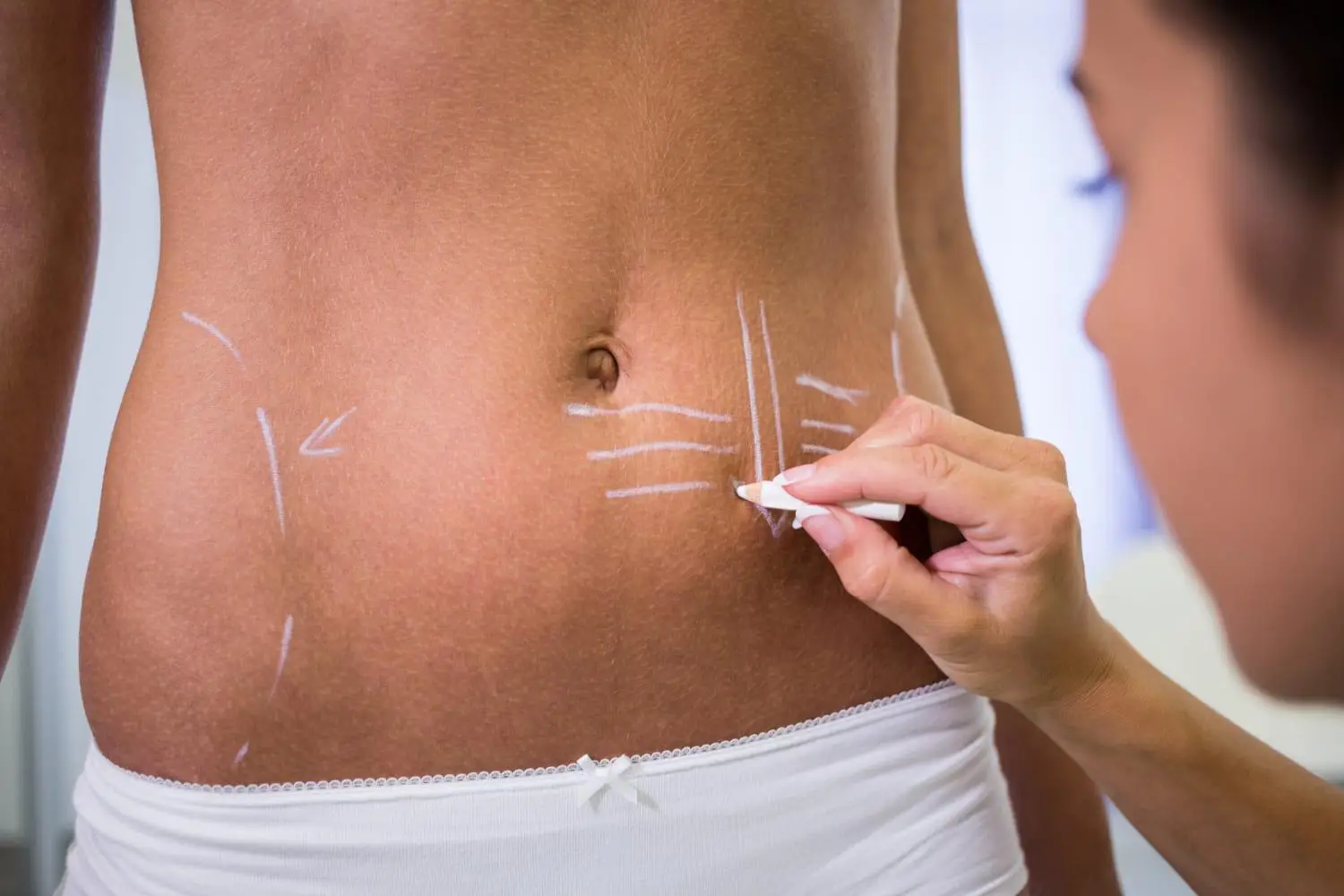
Two people can walk into a consultation wanting the same thing, point at the same part of their body, and correctly be offered two completely different operations. The shape you want to change is not always made of the same tissue.
Excess fat, loose skin and separated abdominal muscle look alike in the mirror and almost identical in a photograph. They are three different problems in three different layers, and no single operation fixes all three. Choosing by procedure name rather than by problem is how people end up disappointed, and sometimes how they end up looking worse than before.
We coordinate treatment in Istanbul with independent partner surgeons, so nothing here replaces an examination: your surgeon assesses your tissue and decides. But knowing which question is being answered makes that consultation far more useful than arriving with a procedure name already chosen.
Fat, skin and muscle are three different problems
In front of a mirror, pinch the tissue you want gone. If it is thick and soft and the skin springs back flat when you let go, you are mostly holding fat. If what you lift is thin, and hangs or creases rather than snapping back, you are holding skin that has lost its elasticity. If your abdomen looks flat lying down but pushes into a firm ridge when you sit up, the issue may be the abdominal wall itself.
Why getting this wrong makes the result worse
This is not an academic distinction. A 2021 review in Seminars in Plastic Surgery states that the surgeon must treat skin tone and soft-tissue excess as separate entities, and that failing to do so “became evident in the early years of liposuction wherein many patients demonstrated evidence of increased skin laxity following their procedure.”
Loose skin drapes over the fat beneath it, and that volume is part of what holds the surface smooth. Take the fat out and the same envelope has less to fill. The review names the cause: skin laxity after liposuction follows either poor skin retraction or “inappropriate use of liposuction monotherapy in a patient who was better suited for excisional or body lift surgical procedures.” Liposuction alone, it concludes, “is unable to effectively address moderate-to-severe redundancies of skin and soft tissue.”
The NHS makes the same point from the patient’s side: liposuction works best in people who are not overweight and where the skin is firm and elastic. That is a condition to be met, not a preference. If your skin no longer retracts, the operation that helps you removes skin, not fat.
The third problem: separated muscle
A 2025 review in Hernia defines rectus diastasis as separation of the rectus abdominis muscles in the midline with subsequent widening of the linea alba, and treats a gap wider than 2 cm above the navel as pathologic. It does not reliably resolve on its own: the same review reports that 33% of women still have persistent rectus diastasis at 12 months postpartum, and that it is present in 52% of women who have had more than one pregnancy against 2% of those who have had one.
This is the problem neither fat removal nor skin excision touches. If the bulge comes from a gap in the muscle wall, the abdomen stays rounded however much fat is suctioned or skin trimmed. Closing it means stitching the muscles back toward the midline, done as part of an abdominoplasty. No injection or device closes a true separation.
Which operation addresses which problem
Each problem maps to the operation that treats it, with recovery figures published by the NHS. Read the left column first: it decides the other two.
| What you actually have | Operation that addresses it | Typical recovery |
|---|---|---|
| Localised fat in a defined area, skin still firm and elastic | Liposuction | Gentle exercise at 3-4 weeks, strenuous activity avoided for 10-12 weeks, swelling up to 6 months |
| Loose abdominal skin that will not retract | Abdominoplasty (tummy tuck), removing skin and fat | A few nights in hospital, about 4-6 weeks off work and exercise, compression garment for 6 weeks |
| A midline bulge from separated abdominal muscles | Muscle repair, performed as part of an abdominoplasty | As abdominoplasty, with lifting restricted while the repair heals |
| Fat moved from the waist to the buttocks | Liposuction with gluteal fat grafting (Brazilian butt lift) | No normal sitting for several weeks, shape settles over months |
| Post-pregnancy change across the abdomen and breasts together | Combined procedures under one anaesthetic (mummy makeover) | Longest of the group, two areas healing at once |
Liposuction and abdominoplasty are not competing versions of the same operation, they answer different questions. And the recovery column is not a detail to skim: an abdominoplasty is measured in weeks off work, which is why the stay in Istanbul is longer for a tummy tuck.
None of these is a weight loss operation
The NHS states that liposuction is not a treatment for obesity, and that it will not remove cellulite or stretch marks. On abdominoplasty it is equally direct: it is not a quick fix for losing weight, and not a procedure for someone who is overweight. These are shaping operations performed on a body that has already arrived at its weight.
Why a stable weight is a clinical requirement
A study published in Obesity Facts in 2011 concluded that a stable weight for at least 3 months before body contouring surgery is associated with a significantly lower complication rate, and emphasised striving for a stable weight close to normal to minimise risk.
Weight shows up in the complication data too. An analysis of 55,596 abdominoplasty patients in the CosmetAssure database between March 2015 and December 2022, published in Aesthetic Surgery Journal in 2024, found an overall major complication rate of 2.1%: haematoma 0.7%, infection 0.6%, pulmonary embolism 0.19%, deep vein thrombosis 0.18%. Patients with a body mass index above 40, and patients with diabetes, had a significantly higher risk, with odds ratios of 1.70 and 1.80.
The practical version: if you are still actively losing weight, the operation is being planned against a body that will not exist in six months, and a result designed around today’s volume will not fit tomorrow’s. Reaching a weight you can hold is part of the preparation.
The Brazilian butt lift needs its own safety conversation
Gluteal fat grafting is the one procedure here where technique is a safety question, not only an aesthetic one. Fat is removed by liposuction and injected into the buttock. If it is placed deep enough to enter a large gluteal vein, it can travel to the lungs as a pulmonary fat embolism.
An Aesthetic Surgery Education and Research Foundation task force reported on this in Aesthetic Surgery Journal in 2017. An anonymous survey went to 4,843 plastic surgeons worldwide; respondents reported 32 fatalities from pulmonary fat emboli and 103 non-fatal ones, with 3% having experienced a patient fatality over their careers. The decisive finding was depth: surgeons who reported injecting into the deep muscle had a significantly increased incidence of both fatal and non-fatal emboli. The task force recommended avoiding the deep muscle, avoiding cannulae smaller than 4 mm, and not pointing the cannula downwards.
What happened next is worth knowing before you book. A 2022 report in the same journal recorded 25 deaths from pulmonary fat embolism after Brazilian butt lift in South Florida alone between January 2010 and April 2022, with fat grafts found within the gluteal musculature in the cases examined after death. Fourteen occurred after the 2018 guidelines and the 2019 Florida rule restricting grafting to the subcutaneous plane were already in place. The same paper notes a 2019 survey putting mortality at 1 in 14,921, so estimates vary widely with how they are collected.
This is not a reason to abandon the procedure, but a reason to ask a specific question. Ask which plane the fat goes into, and how the surgeon confirms they are staying in it. Be wary of an answer that moves straight to reassurance without naming a technique.
Combining operations: the mummy makeover question
A mummy makeover is not a distinct operation. It is a scheduling decision: abdominal and breast procedures under one anaesthetic instead of across two trips. The honest question is not whether it works, but whether combining adds risk.
The larger dataset is reassuring. In the 55,596-patient analysis, after adjusting for other factors, there was no significant added risk of major complications when abdominoplasty was combined with another procedure compared with abdominoplasty alone.
That is not a licence to add everything. A prospective series of 551 consecutive patients published in Plastic and Reconstructive Surgery Global Open in 2013 reported a complication rate of 4.2% after liposuction alone against 50% in patients treated with an abdominoplasty, with seroma after 5.4% of abdominoplasties and none of the liposuction-only cases. The two datasets measure different things rather than contradict each other: the large database tracks major complications, the smaller series counted a much broader definition. Either way, the bigger operation carries the bigger burden.
Recovery is additive even where statistical risk is not. Healing an abdominal repair and breast surgery at once is harder than either alone, and the early days need more help at home than most people plan for. If you are travelling, arrange that support in advance.
One timing question deserves asking out loud. Given how strongly muscle separation tracks with repeated pregnancy in the figures above, whether to repair the abdominal wall before or after any further pregnancies is a surgical decision, not a lifestyle footnote. Raise it rather than leaving the surgeon to guess.
What to take into the consultation
You do not need a diagnosis. You do need the information that lets someone else make one.
- Your weight history: highest and current weight, how you lost any weight, and how long you have held this one.
- Whether you have been pregnant, how many times, and whether a midline ridge appears when you sit up.
- Any previous abdominal surgery, including caesarean section, and where the scars sit.
- Your full medical history: diabetes, clotting disorders, smoking, and every medication and supplement you take.
- The result you want described in plain language rather than as a procedure name.
Expect limits in the answer. A surgeon who tells you what an operation cannot do, or declines to combine everything into one trip because the recovery would not be safe, is giving you better information than one who simply agrees with you. No procedure here produces a guaranteed outcome.
We coordinate the hospital, the appointments, the interpreting and the travel. The assessment, the choice of operation and the surgery belong to an independent partner surgeon in Istanbul, who decides after examining you. If their answer differs from what you expected here, that is the assessment doing its job rather than a setback.
Sources
- NHS, Liposuction
- NHS, Tummy tuck (abdominoplasty)
- Seminars in Plastic Surgery, 2021: Avoidance and Correction of Deformities in Body Contouring
- Hernia, 2025: Abdominoplasty and rectus diastasis repair, a plastic surgeon’s perspective
- Aesthetic Surgery Journal, 2024: Complications and Risks Associated With the Different Types of Abdominoplasties (CosmetAssure database)
- Plastic and Reconstructive Surgery Global Open, 2013: Prospective Clinical Study of 551 Cases of Liposuction and Abdominoplasty Performed Individually and in Combination
- Obesity Facts, 2011: Complications after body contouring surgery in post-bariatric patients, the importance of a stable weight close to normal
- Aesthetic Surgery Journal, 2017: Report on Mortality from Gluteal Fat Grafting, Recommendations from the ASERF Task Force
- Aesthetic Surgery Journal, 2022: Brazilian Butt Lift-Associated Mortality, The South Florida Experience