
Article
Gastric Sleeve Weight Loss Timeline: What to Expect at 3, 6 and 12 Months

An independent partner surgeon checked the medical claims on this page. What applies to your own case is decided by the surgeon who examines you.
Written by the editorial team, not by a clinician. Nothing here is medical advice: your independent partner surgeon decides what applies to you.

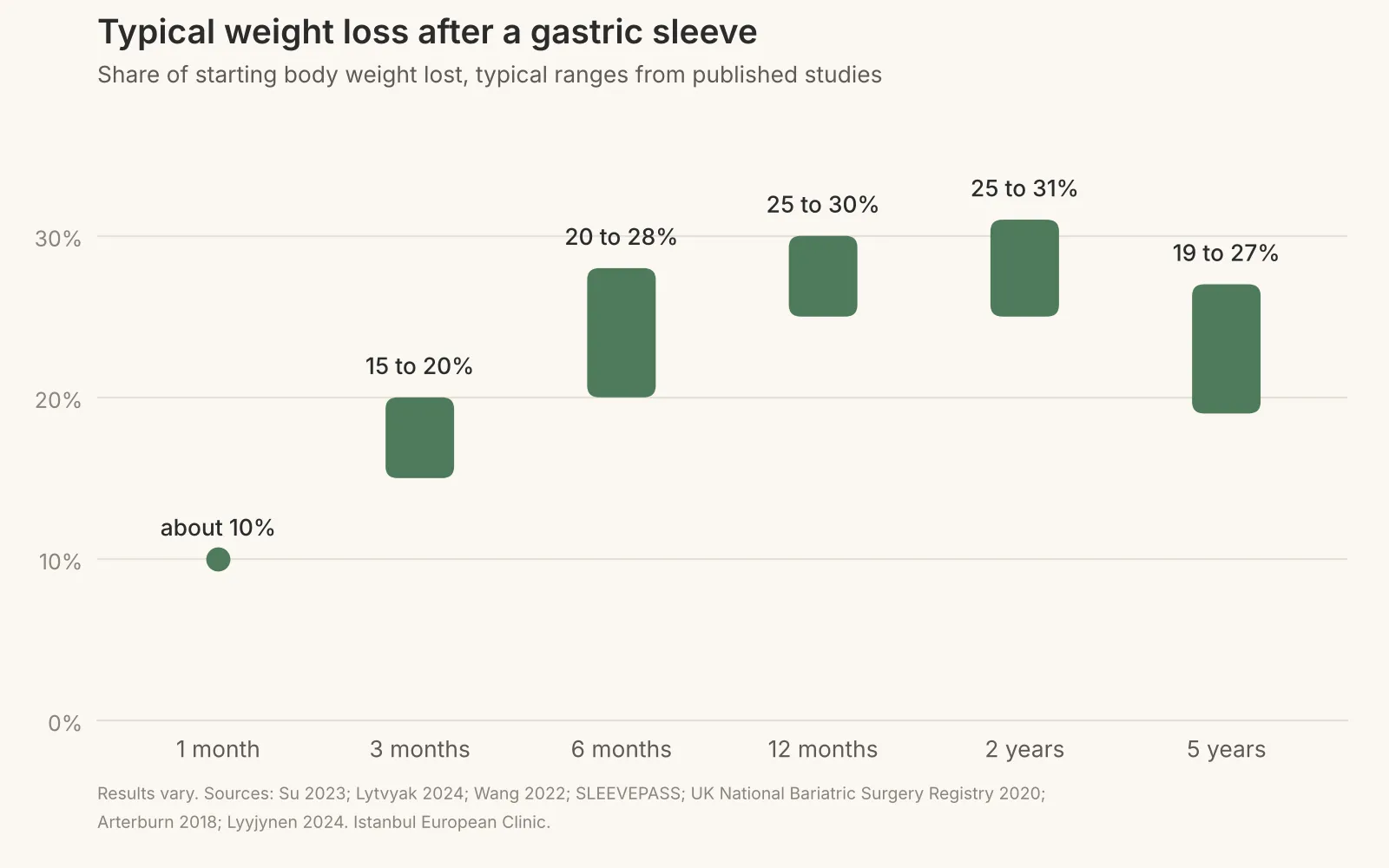
Gastric sleeve before and after 3 months: most people have lost about 15 to 20% of their starting weight by then, and about 25 to 30% by one year (1, 2, 3, 4). Weight comes off fastest in the first few months and then slows, which is normal. Your own numbers will depend on your starting weight, your health and how closely you follow your aftercare.
This guide sets out what the studies show at each stage, what else changes along the way, and how to tell whether you are on track.
| Time after surgery | Typical share of starting weight lost | What else is usually happening |
|---|---|---|
| 1 month | About 10% (1) | Fluids, then runny food; activity built up gradually (5) |
| 3 months | About 15 to 20% (1, 2) | Back to normal textures in small portions; hair thinning may start (5, 7) |
| 6 months | About 17 to 28% (2) | Loss has slowed; regular exercise matters more (8) |
| 12 months | About 25 to 30% on average (3, 4) | Many weight-related conditions have improved (9) |
| 12 to 24 months | Lowest weight usually reached (10) | Some people start to regain a little (11) |
What these numbers mean for you
To turn the percentages into kilograms or pounds, multiply your starting weight by them. These are typical ranges, not predictions, and many people sit outside them.
| Starting weight | By 3 months | By 6 months | By 12 months |
|---|---|---|---|
| 100 kg (220 lb) | 15 to 20 kg (33 to 44 lb) | 17 to 28 kg (37 to 62 lb) | 25 to 30 kg (55 to 66 lb) |
| 130 kg (287 lb) | 20 to 26 kg (43 to 57 lb) | 22 to 36 kg (49 to 80 lb) | 32 to 39 kg (72 to 86 lb) |
| 160 kg (353 lb) | 24 to 32 kg (53 to 71 lb) | 27 to 45 kg (60 to 99 lb) | 40 to 48 kg (88 to 106 lb) |
Total weight loss vs excess weight loss
Weight-loss figures are quoted in two different ways, which is why websites give such different numbers for the same month:
- Total weight loss is the share of your starting weight you have lost.
- Excess weight loss is the share of your "excess" weight you have lost, meaning the weight above a BMI of 25 (2).
Take someone who is 1.70 m tall and weighs 130 kg. About 58 kg of that is "excess". If they lose 23 kg, that is about 18% of their total weight but about 40% of their excess weight. This guide uses total weight loss unless it says otherwise. It is also the measure specialists use to judge whether someone has responded well to surgery (13).
The first month
Most people leave hospital 1 to 3 days after surgery (5). For the first 2 weeks you have water and fluids such as thin soup, then runny or puréed food in weeks 3 and 4 (5). Your team may give you a slightly different plan, so follow theirs.
This is when weight drops fastest. In one study of 408 people, the average loss was about 10% of starting weight by the end of the first month (1). The pace will not last, and that is normal.
Increase your activity gradually from the start. Most people begin returning to their normal activities after 4 to 6 weeks (5).
Gastric sleeve before and after 3 months
By 3 months, studies put average weight loss at about 15 to 20% of starting weight (1, 2). For someone who started at 130 kg, that is roughly 20 to 26 kg. The weekly loss is now slower than in the first month, and that is expected.
What else is usually happening around the 3-month mark:
- Food: soft food from week 5, then a gradual return to a normal, balanced diet in small portions from about week 8 (5). Aim for at least 60 g of protein a day, or the amount your dietitian sets (8).
- Supplements and blood tests: after a sleeve you need a daily multivitamin and mineral, iron and vitamin D, enough calcium in your diet, and vitamin B12 injections every 3 months. Blood tests are recommended at 3, 6 and 12 months, then at least once a year for life (14).
- Hair thinning: about half of people notice some after a sleeve (7). It is usually temporary: in one study included in a review, it started at around 3 months on average and stopped at about 9 months (7). Enough protein and taking your supplements matter here.
- Health changes: blood pressure and blood sugar can improve quickly. In one trial, by 6 months high blood pressure had resolved or improved in about 3 in 4 people, and type 2 diabetes in about 4 in 5 (15). If you take medicines for diabetes or blood pressure, your doctor may need to adjust them as you lose weight.
- Gallstones: they can form during fast weight loss, so tell your team about any tummy pain (16).
How much you have lost by now is a useful early guide. Studies have found that weight loss at 3 months helps predict how much people go on to lose (1, 17).
At 6 months
By 6 months, most people have lost about 17 to 28% of their starting weight (2). This is the stage with the least data, so treat the range as a rough guide. How much you have lost by 6 months also helps predict your longer-term result (6). In one randomised trial, people had lost about half of their excess weight by 6 months (15).
Weight loss keeps slowing, and activity becomes more important. Specialist guidance recommends working up to at least 150 minutes of moderate activity a week, with a goal of 300, plus strength exercises 2 or 3 times a week (8). In a review of exercise programmes after weight loss surgery, exercise added about 1.8 kg of extra weight loss and improved fitness (18). You should also have your 6-month blood tests (14).
At 12 months
One year after a sleeve, the average loss is about 25 to 30% of starting weight. In the UK national registry, the average was 29%, and half of people lost between 23% and 36% (3). A study of more than 29,000 sleeve patients in the US found an average of 25% (4). People with type 2 diabetes tend to lose a little less (23).
Weight-related conditions often improve by now. In the same trial of people with type 2 diabetes, 48% were in remission one year after a sleeve (9).
One change to watch for is reflux. About 1 in 4 people develop new heartburn or reflux after a sleeve (19), so mention any symptoms at your follow-up. Our gastric sleeve page explains the long-term reflux evidence.
If you are thinking about pregnancy, UK guidance advises waiting 12 to 18 months after surgery, until your weight has settled (5, 14). Weight loss can make you more fertile, so use reliable contraception in the meantime and ask your team which method suits you (5, 20).
After the first year
Most people reach their lowest weight between 12 and 24 months. In one study, 37% reached it at 12 months, 19% at 18 months and 13% at 24 months (10). At 2 years, registries in Sweden, the Netherlands and Norway reported average losses of 26% to 31% (21).
After that, some weight usually returns. How common this is depends on how regain is defined: estimates range from under 1 in 10 people at 2 years to most people by 6 years (11). In the large US study, average loss was 19% at 5 years, down from 25% at 1 year (4). Diet support, activity, regular follow-up and, where suitable, medicines can help (8). Our guide to gastric sleeve pros and cons covers the long-term picture in more detail.
Why weight loss slows
Several things slow the pace after the first few months. As you get lighter, your body needs less energy, and one study found that resting energy use fell more than expected after weight loss surgery (22). You also move from fluids back to normal food over the first 2 months (5).
Weight rarely drops in a straight line, and some people notice the scales stall for a week or two. Look at the trend over several weeks rather than day to day (12), and talk to your team if you are worried.
Am I on track?
Work out your total weight loss as a percentage of your starting weight, then compare it with the ranges above. For example, losing 45 lb (20 kg) in 10 months is 18% if you started at 250 lb (113 kg), but 13% if you started at 350 lb (159 kg).
Specialists describe losing less than 20% of your starting weight as a "suboptimal response" (13). It affects about 1 in 5 people at 2 years (21). It is not a failure, and there are options, from diet and activity support to medicines.
Things that are linked to how much people lose:
- Health and age: people with type 2 diabetes, men and older adults tend to lose a little less (9, 23).
- Follow-up: in one study, people who had a sleeve and attended all their follow-up visits had lost twice as much excess weight at 5 years as those who did not (24).
- Activity: exercise adds to weight loss (18).
- Early pace: in one study of sleeve and bypass patients, about 4 in 5 people who lost less than about 0.5 kg (1 lb) a week between months 3 and 6 did not reach 20% weight loss (10). If your loss slows early, tell your team then, rather than waiting.
How to read before-and-after photos
Before-and-after photos show what is possible, not what is typical. Clinics usually choose their best results. When you look at one, check:
- how long after surgery the "after" photo was taken
- the starting weight and height, if given
- whether the lighting, pose, clothing and camera distance are the same in both photos
- whether the person agreed to their photos being used, and whether any images are models
Your own progress photos are more useful. Take them once a month in the same spot, light and clothing, from the front and side, and note your weight and waist measurement on the same day. How your clothes fit often changes before the scales do.
Loose skin
Loose skin is common after large weight loss. In one survey, 78% of people reported excess skin after bariatric surgery (25). It is most often around the tummy, breasts, hips, arms and legs (16). Skin-removal surgery is usually considered only once your weight has been stable for at least 12 months, which is typically 12 to 18 months after a sleeve (8, 26). On the NHS it is not always available (16).
Supplements and follow-up for life
NICE recommends at least 2 years of follow-up with a specialist bariatric team, then a check of your nutrition and supplements at least once a year for life (27). Your blood tests at 3, 6 and 12 months, and your B12 injections every 3 months, are part of this (14).
If you have surgery away from home, agree before you go who will do your blood tests, injections and yearly reviews when you are back. Our bariatric surgery patient guide covers how to prepare.
Warning signs
Call 999 in the UK, or 911 in the US, or go to A&E if you have (16):
- difficulty breathing or chest pain, with pain and swelling in your leg
- severe tummy pain
- vomit with blood in it, or vomit that looks like coffee grounds
- a lot of bleeding, or bleeding from your bottom that will not stop
Contact your surgical team, call NHS 111 or get an urgent GP appointment if you have a high temperature or feel shivery, a fast heartbeat, fast breathing, tummy pain, difficulty swallowing, regular vomiting, or a leg that is red, swollen or painful (16). Tell any doctor which operation you had and where.
Frequently asked questions
How much weight can you lose 3 months after a gastric sleeve?
Usually about 15 to 20% of your starting weight (1, 2). From 130 kg (287 lb), that is roughly 20 to 26 kg (43 to 57 lb).
How much weight will I lose in the first month?
About 10% of your starting weight on average, the fastest pace you will see (1). The rate slows after that, which is normal.
Why have I only lost 45 pounds 10 months after my sleeve?
It depends on your starting weight: 45 lb is 18% from 250 lb but 13% from 350 lb. Below 20% by one year is worth discussing with your team, who can help (13).
When does weight loss stop after a gastric sleeve?
Most people reach their lowest weight between 12 and 24 months after surgery (10). Some weight often returns after that (11).
Does everyone get loose skin?
Most people get some: 78% reported excess skin in one survey (25). Skin removal is usually considered after 12 months of stable weight (26).
When does hair loss stop?
It is usually temporary. Hair thinning often starts around 3 months and settles within the first year (7). Protein and supplements help.
How long should I wait to get pregnant after a gastric sleeve?
UK guidance advises 12 to 18 months, until your weight has settled. Use reliable contraception until then (5, 14).
Is it normal to regain some weight?
Yes, some regain after the first year or two is common (11). Follow-up, diet support, activity and sometimes medicines can help (8).
Next steps
If you are considering a sleeve, use the ranges above to set realistic expectations, and ask your surgeon what they would expect for someone with your weight and health. Plan your supplements and follow-up before surgery, not after. Istanbul European Clinic does not provide surgery; every clinical decision is made by your independent partner surgeon.
Thinking about a gastric sleeve?
Read how the operation works, what the long-term results show, the reflux risk and what aftercare involves, then send us your questions.
Explore gastric sleeve surgerySources
- Su YT, Su YH, et al. Prediction of 5-Year Weight Loss and Weight Regain According to Early Weight Loss after Sleeve Gastrectomy. Obesity Surgery, 2023;33(5):1366-1372.
- Lytvyak E, Zarrinpar A, et al. Stronger control of eating 3 months after sleeve gastrectomy predicts successful weight loss outcomes at one year. Obesity Pillars, 2024;11:100111.
- Small P, Mahawar K, et al. The UK National Bariatric Surgery Registry: Third Report. Dendrite Clinical Systems for the British Obesity and Metabolic Surgery Society (BOMSS), 2020.
- Arterburn D, et al. Comparative Effectiveness and Safety of Bariatric Procedures for Weight Loss: A PCORnet Cohort Study. Annals of Internal Medicine, 2018;169(11):741-750.
- NHS. Weight loss surgery: recovery.
- Wang L, Tian C, et al. Long-Term Weight Loss Outcome of Laparoscopic Sleeve Gastrectomy Predicted by the Percentage of Excess Weight Loss at 6 Months in Chinese Patients with Body Mass Index ≥ 32.5 kg/m2. Diabetes, Metabolic Syndrome and Obesity, 2022;15:2235-2247.
- Zhang W, Fan M, et al. Hair Loss After Metabolic and Bariatric Surgery: a Systematic Review and Meta-analysis. Obesity Surgery, 2021;31(6):2649-2659.
- Mechanick JI, et al. Clinical practice guidelines for the perioperative nutrition, metabolic, and nonsurgical support of patients undergoing bariatric procedures, 2019 update (AACE, TOS, ASMBS, OMA, ASA). Surgery for Obesity and Related Diseases, 2020;16(2):175-247.
- Fatima F, Hjelmesæth J, et al. Gastrointestinal Hormones and β-Cell Function After Gastric Bypass and Sleeve Gastrectomy: A Randomized Controlled Trial (Oseberg). Journal of Clinical Endocrinology and Metabolism, 2022;107(2):e756-e766.
- Manning S, et al. Early postoperative weight loss predicts maximal weight loss after sleeve gastrectomy and Roux-en-Y gastric bypass. Surgical Endoscopy, 2015;29(6):1484-1491.
- Lauti M, et al. Weight Regain Following Sleeve Gastrectomy: a Systematic Review. Obesity Surgery, 2016;26(6):1326-1334.
- Obesity Action Coalition. Dear Doctor: weight loss after bariatric surgery. Your Weight Matters Magazine, Spring 2020.
- Salminen P, et al. IFSO Consensus on Definitions and Clinical Practice Guidelines for Obesity Management: an International Delphi Study. Obesity Surgery, 2024;34(1):30-42.
- O'Kane M, et al. British Obesity and Metabolic Surgery Society Guidelines on perioperative and postoperative biochemical monitoring and micronutrient replacement for patients undergoing bariatric surgery: 2020 update. Obesity Reviews, 2020;21(11):e13087.
- Helmiö M, et al. Comparison of short-term outcome of laparoscopic sleeve gastrectomy and gastric bypass in the treatment of morbid obesity: A prospective randomized controlled multicenter SLEEVEPASS study with 6-month follow-up. Scandinavian Journal of Surgery, 2014;103(3):175-181.
- NHS. Weight loss surgery: complications.
- Tettero OM, Monpellier VM, et al. Early Postoperative Weight Loss Predicts Weight Loss up to 5 Years After Roux-En-Y Gastric Bypass, Banded Roux-En-Y Gastric Bypass, and Sleeve Gastrectomy. Obesity Surgery, 2022;32(9):2891-2902.
- Bellicha A, et al. Effect of exercise training after bariatric surgery: a systematic review and meta-analysis. Obesity Reviews, 2021;22(S4):e13296.
- Rebecchi F, Ugliono E, et al. Reflux following bariatric surgery. Mini-invasive Surgery, 2022;6:30.
- Armstrong C. ACOG Guidelines on Pregnancy After Bariatric Surgery. American Family Physician, 2010;81(7):905-906.
- Lyyjynen HS, Andersen JR, et al. Surgical Aspects of Sleeve Gastrectomy Are Related to Weight Loss and Gastro-esophageal Reflux Symptoms. Obesity Surgery, 2024;34(3):902-910.
- Tam CS, Rigas G, et al. Energy Adaptations Persist 2 Years After Sleeve Gastrectomy and Gastric Bypass. Obesity Surgery, 2016;26(2):459-463.
- Patel S, Jiang C, et al. Socio-Demographic and Preoperative Clinical Factors Associated With 5-Year Weight Trajectories After Roux-en-Y Gastric Bypass and Sleeve Gastrectomy. Annals of Surgery Open, 2024;5(2):e437.
- Luján J, Tuero C, et al. Impact of Routine and Long-Term Follow-Up on Weight Loss after Bariatric Surgery. Obesity Surgery, 2020;30(11):4293-4299.
- Jiang Z, Zhang G, et al. Experience of Excess Skin and Attitude to Body Contouring Surgery of a Chinese Post-Bariatric Population. Obesity Facts, 2021;14(5):501-509.
- British Association of Plastic, Reconstructive and Aesthetic Surgeons (BAPRAS). Body contouring.
- National Institute for Health and Care Excellence (NICE). Overweight and obesity management (NG246), 2025: medicines and surgery.