
Article
Veneers vs Crowns: Which Is Right for You?

An independent partner dentist checked the medical claims on this page. What applies to your own case is decided by the dentist who examines you.
Written by the editorial team, not by a clinician. Nothing here is medical advice: your independent partner surgeon decides what applies to you.
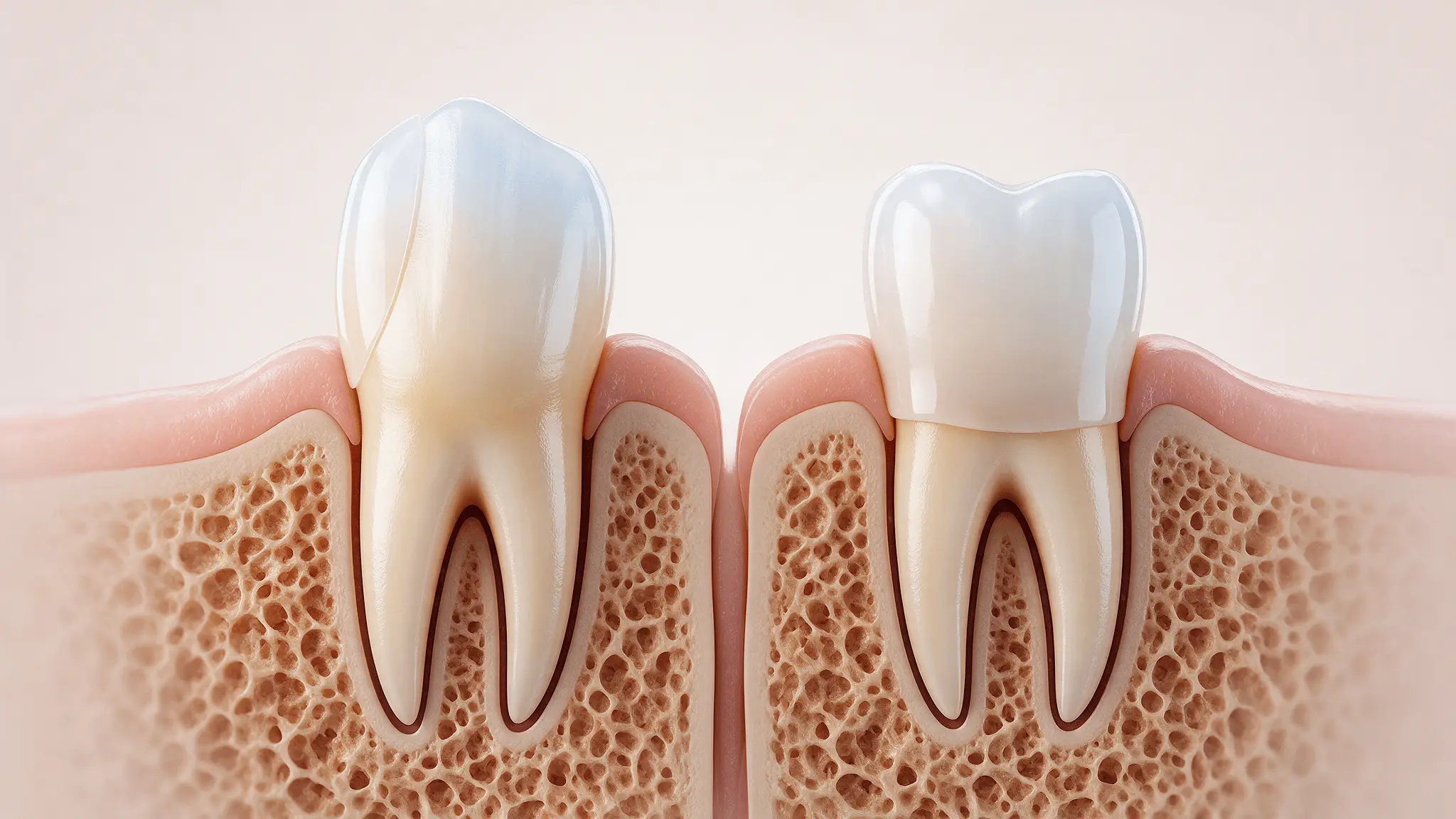
A veneer is a thin shell bonded to the front of a tooth. A crown is a cap that covers the whole visible tooth. The difference that matters most is how much of your own tooth each one removes: in a laboratory study on front teeth, veneer preparations took about 3% to 30% of the tooth above the gum, and crown preparations took about 63% to 72% (1). That is why veneers usually suit healthy front teeth that need a cosmetic change, and crowns usually suit teeth that are broken, heavily filled or root treated.
Both are permanent once the tooth has been prepared. This guide covers how long each lasts, what happens when they fail, who should be careful with veneers, and the gentler options that sometimes make both unnecessary.
Veneers vs crowns at a glance
| Veneer | Crown | |
|---|---|---|
| What it covers | The front surface of the tooth | The whole visible tooth |
| Tooth removed | About 3% to 30% | About 63% to 72% |
| Typical use | Colour, shape, chips and small gaps on healthy front teeth | Broken, cracked, heavily filled or root-treated teeth |
| Survival | About 96% at 10 years and 91% at 20 years for porcelain | About 92% to 97% at 5 years, depending on material |
| Most common problem | Chipping or coming loose | Chipping, decay at the edge, nerve problems |
| Reversible? | No | No |
The core difference: how much tooth each removes
What a veneer is
A veneer is a thin layer of porcelain or composite resin bonded to the front of a tooth. To make room for it, the dentist usually shapes a fraction of a millimetre of enamel from the front surface. The back and sides of the tooth are left alone. Composite veneers can sometimes be placed with less enamel removed than porcelain ones (11).
What a crown is
A crown is a cap made of ceramic, metal-ceramic or metal that covers the tooth on every side. To fit it, the tooth is reduced all the way round and on the biting edge, which leaves a smaller core underneath.
Why the amount matters
Enamel does not grow back, so whatever is removed is removed for life. The amount also affects how well a veneer works. Veneers bond most reliably to enamel: in a study of 580 porcelain veneers followed for up to 12 years, veneers bonded mostly to the softer dentine underneath were about ten times more likely to fail than those bonded to enamel (10). A veneer that needs deep preparation to work is often a sign that a different treatment would suit the tooth better.
How long veneers and crowns last
Survival here means the restoration was still in place at the end of the study. Some had been repaired along the way.
- Porcelain veneers: a review of 11 studies found about 96% survival at both 5 and 10 years (3). One long-term study of 499 veneers found 96% survival at 10 years and 91% at 20 years (2). A 2016 review found glass-ceramic veneers did slightly better than traditional feldspathic porcelain (4).
- Composite veneers: pooled survival was about 88% over two to eight years in one review (13). In a small 10-year trial, lab-made composite veneers fared worse than ceramic ones (18). Composite is easier to repair, but it stains and wears more (11).
- Crowns: a review of about 14,000 crowns found 5-year survival of 94.7% for metal-ceramic, 96.6% for lithium disilicate and 92.1% for zirconia crowns. Zirconia crowns had more chipping of their outer porcelain layer and more loosening (5). In one dental practice, 97% of 2,340 metal-ceramic crowns were still in place at 10 years (6). Our page on zirconium crowns covers that material in more detail.
The two treatments last a similar length of time when they are chosen for the right tooth. Choosing between them on lifespan alone misses the bigger difference, which is how much tooth each one removes.
What happens when they fail
How veneers fail
In a 2016 review, the most common veneer problem was chipping or fracture (about 4%), followed by debonding, discoloured edges and nerve problems (about 2% each), with new decay at about 1% (4). A chipped or loose veneer can often be repaired or replaced on the same tooth.
How crowns fail
A review of single crowns found complications in about 11%. The most common were the tooth needing root canal treatment (3%), porcelain fracture (3%) and the crown coming loose (2%) (7).
The nerve risk after crowning a healthy tooth
Preparing a tooth for a crown can damage the nerve inside it. A review of 37 studies found the nerve died in about 5% of teeth after crowns and similar restorations, rising to about 7% in studies that followed patients for more than ten years (8). In one study of metal-ceramic crowns placed on teeth with healthy nerves, about 16% had lost nerve vitality within ten years (9). For veneers, nerve problems were reported in about 2% (4). These figures come from separate studies, not a direct comparison, but they point the same way.
Each replacement starts from less tooth
Restorations are replaced over a lifetime, and each step usually takes a little more tooth. A failed veneer can often be replaced with another veneer. When too little enamel is left, the next step is a crown. A crowned tooth that loses its nerve needs root canal treatment, and a tooth that eventually breaks or cannot be saved may need a dental implant. Starting with the treatment that removes the least tooth keeps more of those later options open.
When a crown is the better choice
- The tooth is broken, cracked or heavily filled. A crown holds a weakened tooth together and covers what a veneer cannot (16).
- It is a root-treated back tooth. In one study of 203 root-treated teeth, those without a crown were lost about six times as often as those with one (14).
- The tooth already has a crown. Too little enamel is left for a veneer, so a replacement crown is the usual answer.
Our page on dental crowns covers materials and what the treatment involves.
When a veneer is the better choice
Veneers are designed to change how front teeth look (15). They tend to suit you when:
- the tooth is healthy and the concern is cosmetic: colour that whitening has not fixed, small chips, small gaps or an uneven shape
- there is enough enamel left to bond to
- you do not grind your teeth heavily
Our page on dental veneers covers the materials and what the treatment involves.
Front teeth: veneers or crowns?
For a healthy front tooth that needs a cosmetic change, a veneer is usually the more conservative choice, because it leaves most of the tooth in place (1). A crown on a front tooth makes more sense when the tooth is root treated with little structure left, heavily filled, broken, or very dark from the inside in a way a thin veneer cannot hide.
Crowning several healthy front teeth only to change their colour or shape removes far more tooth than that goal needs. If a plan proposes crowns on front teeth that have no fillings, cracks or root treatment, ask why a veneer or a less invasive option would not do the job.
When neither is the right answer
Professional guidance favours the least invasive option that meets the goal, and several cosmetic concerns can be treated without veneers or crowns (19).
- Discoloured but healthy teeth: whitening removes no tooth and is usually worth trying first.
- Small chips or gaps: composite bonding adds material to the tooth with little or no drilling.
- Crooked teeth: braces or clear aligners move the teeth. Veneers only hide their position.
- A damaged back tooth with some walls intact: an onlay or partial crown covers the damaged part and keeps more of the healthy tooth.
Who should be careful with veneers
- People who grind or clench, or have a deep overbite. The American Dental Association notes veneers may not be a good choice in these cases (11). A review linked night-time grinding with failure of front-tooth ceramic veneers, though the evidence was of very low quality (12).
- Thin or worn enamel. Veneers bonded to dentine fail more often (10).
- Gum disease or decay. These need treating first. Placing veneers over unhealthy teeth can make existing problems worse (11).
Decision guide by situation
Use this as a starting point for a conversation with your dentist, not as a substitute for one.
| If your tooth… | Usually… | Why |
|---|---|---|
| Is healthy but discoloured | Whitening first, then a veneer if that fails | Whitening removes no tooth |
| Is healthy with a small chip or gap | Composite bonding or a veneer | Both keep most of the tooth |
| Is crooked but healthy | Braces or aligners | Veneers hide position without moving the tooth |
| Has a large filling or a crack | A crown, or an onlay if enough tooth remains | The weakened tooth needs covering and holding together |
| Is a root-treated back tooth | A crown | Uncrowned root-treated teeth are lost more often |
| Already has a crown | A replacement crown | Too little enamel is left for a veneer |
| Belongs to someone who grinds heavily | A careful assessment, often with a night guard | Grinding is a recognised risk for veneers |
Why some dentists push crowns, and how to check a plan
When the British Dental Association surveyed 1,000 UK dentists, 86% said they had treated patients for problems after dental treatment abroad. Crowns were the treatment they most often had to deal with, and dentists described healthy teeth that had been heavily prepared (17).
A plan should explain, tooth by tooth, why each one needs treatment and why a less invasive option was ruled out. Our article on Turkey teeth gone wrong covers what goes wrong in these cases and the questions to ask before agreeing to any plan.
Frequently asked questions
Which lasts longer, veneers or crowns?
Both often last well over a decade. Porcelain veneers showed 91% survival at 20 years in one long study (2), and crowns show about 92% to 97% survival at five years, depending on the material (5).
Why do dentists advise against veneers?
Usually because the tooth is not suitable: heavy grinding, a deep bite, too little enamel, or untreated decay or gum disease (11). Some suggest trying whitening or bonding first, because veneers remove enamel permanently.
Can you get a veneer on a root-treated tooth?
Sometimes, on a front tooth with plenty of healthy structure left. Root-treated back teeth and heavily filled teeth usually need a crown, which protects them better (14).
Can teeth decay under veneers or crowns?
Yes. Decay can start where the edge of the restoration meets the tooth. Biological problems such as decay caused most crown failures in one 25-year study (6). Brushing that edge and regular check-ups help prevent it.
Can you have veneers and crowns in the same smile?
Yes. Many smiles combine crowns on damaged teeth with veneers on healthy ones. The dentist matches the shade across both, so any whitening needs to happen before either is made.
Can veneers or crowns be whitened?
No. Whitening changes the colour of natural teeth, not porcelain or composite. If you want whiter teeth, whiten first and have the veneers or crowns matched to the new shade.
Which looks more natural?
Both can look natural when well made. A veneer keeps more of the natural tooth behind it, while a crown can hide a dark tooth more fully. The dentist's skill and the material matter more than the type.
Next steps
If your teeth point towards one option, the next step is an examination with x-rays, so a dentist can confirm which teeth are healthy and what each one needs. Istanbul European Clinic does not provide dental treatment; every clinical decision is made by your independent partner dentist.
Not sure whether veneers or crowns suit your teeth?
Send us your questions and, if you have them, recent photos or x-rays. A coordinator will arrange a free consultation with an independent partner dentist, so you can decide with the full picture.
Request a free consultationSources
- Edelhoff D, Sorensen JA. Tooth structure removal associated with various preparation designs for anterior teeth. Journal of Prosthetic Dentistry, 2002.
- Layton DM, Walton TR. The up to 21-year clinical outcome and survival of feldspathic porcelain veneers: accounting for clustering. International Journal of Prosthodontics, 2012.
- Layton DM, Clarke M, Walton TR. A systematic review and meta-analysis of the survival of feldspathic porcelain veneers over 5 and 10 years. International Journal of Prosthodontics, 2012.
- Morimoto S et al. Main clinical outcomes of feldspathic porcelain and glass-ceramic laminate veneers: a systematic review and meta-analysis of survival and complication rates. International Journal of Prosthodontics, 2016.
- Sailer I et al. All-ceramic or metal-ceramic tooth-supported fixed dental prostheses (FDPs)? A systematic review of the survival and complication rates. Part I: Single crowns (SCs). Dental Materials, 2015.
- Walton TR. The up to 25-year survival and clinical performance of 2,340 high gold-based metal-ceramic single crowns. International Journal of Prosthodontics, 2013.
- Goodacre CJ et al. Clinical complications in fixed prosthodontics. Journal of Prosthetic Dentistry, 2003.
- Al-Manei KK et al. Incidence and influential factors in pulp necrosis and periapical pathosis following indirect restorations: a systematic review and meta-analysis. BMC Oral Health, 2023.
- Cheung GSP, Lai SCN, Ng RPY. Fate of vital pulps beneath a metal-ceramic crown or a bridge retainer. International Endodontic Journal, 2005.
- Gurel G et al. Influence of enamel preservation on failure rates of porcelain laminate veneers. International Journal of Periodontics and Restorative Dentistry, 2013.
- American Dental Association, MouthHealthy. Veneers.
- de Souza Melo G et al. Association of sleep bruxism with ceramic restoration failure: a systematic review and meta-analysis. Journal of Prosthetic Dentistry, 2018.
- Lim TW, Tan SK, Li KY, Burrow MF. Survival and complication rates of resin composite laminate veneers: a systematic review and meta-analysis. Journal of Evidence-Based Dental Practice, 2023.
- Aquilino SA, Caplan DJ. Relationship between crown placement and the survival of endodontically treated teeth. Journal of Prosthetic Dentistry, 2002.
- Oral Health Foundation. Veneers.
- Oral Health Foundation. What are dental crowns?
- British Dental Association. UK dentists picking up the pieces from dental tourism boom.
- Gresnigt MMM et al. Randomized clinical trial on indirect resin composite and ceramic laminate veneers: up to 10-year findings. Journal of Dentistry, 2019.
- American Dental Association, MouthHealthy. Ways to improve your smile.